-
21-07-2026
ARTICLE NO.167 | The Effect of Hinge Placement on Door Warping: Why Top and Bottom Hinges Aren't Interchangeable
A door hinge is often treated as a generic component—one hinge is much like another, and as long as it is screwed firmly into place, it will do its job. This assumption breaks down when the hinge is considered not as an isolated piece of hardware but as part of a load-bearing system in which position, orientation, and the structural integrity of the surrounding frame all determine whether the door hangs straight or warps over time. Top and bottom hinges may appear identical, but they perform fundamentally different roles. Swapping them, or failing to reinforce the frame corner where the top hinge concentrates its load, invites a slow distortion of the door that no amount of hinge adjustment can correct. A Corner Brace at the top corner of the frame is often the hidden component that prevents this distortion from beginning.
-
12-07-2026
ARTICLE NO.163 | What Is an Angle Bracket? The L-Shaped Metal Piece That Holds Things Together
An angle bracket is one of those humble hardware items that rarely attracts attention, yet holds together a surprising amount of the built environment. Shaped like the letter L, it bridges two surfaces meeting at a right angle and transfers loads between them. In timber framing, furniture assembly, shelving, and architectural metalwork, this simple component prevents joints from racking, shelves from sagging, and frames from twisting under load. A Corner Brace is a specific type of angle bracket designed for heavier structural applications, particularly in window and door frame construction where the forces concentrated at frame corners demand reinforcement beyond what the joint alone can provide.
-
23-06-2026
ARTICLE NO.154 | Can You Fix a Loose Hinge by Changing Just the Screws?
A door that sags, scrapes the floor, or rattles in its frame often traces its problem to a loose hinge. The immediate and instinctive repair is to tighten the existing screws. When that fails—as it frequently does—the next step is to replace the screws with longer, thicker, or differently threaded alternatives. This approach sometimes works, but just as often provides only temporary relief before the same looseness returns. Understanding what actually happens when hinge screws loosen, and what role the surrounding structure plays, reveals whether a screw change alone can solve the problem or whether deeper intervention is required. In many cases, the hinge itself is not the root cause. The frame corner, reinforced by a Corner Brace, is where the real story begins.
-
02-06-2026
ARTICLE NO.143 | Hinge vs. Friction Stay: What's the Difference?
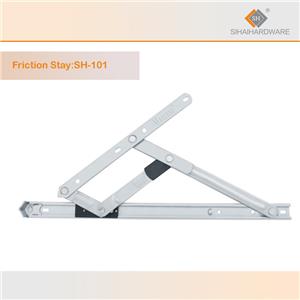
When a casement window swings open and holds its position against the breeze, two distinct mechanisms are at work. Most people see only one piece of hardware, but the hinge and the friction stay perform fundamentally different jobs. Confusing them leads to misdiagnosed problems, wasted replacement parts, and windows that never quite work properly. Understanding what each component does—and does not do—is the first step toward proper specification, maintenance, and repair. A Corner Brace supports the frame joint where the forces from both components concentrate, while the window friction stay handles a very specific task that the hinge cannot perform.
-
18-05-2026
ARTICLE NO.136 | The Fatigue Threshold: How Many Cycles Before Your Continuous Hinge Fails?
The Corner Brace in architectural hardware is typically associated with static reinforcement—a rigid bracket resisting racking, shear, and torsional deformation. Yet in automated doors, high-traffic entrances, and industrial access panels, Corner Braces endure cyclic loading far beyond static design assumptions. Every opening and closing cycle introduces stress fluctuations that can initiate and propagate fatigue cracks over time. Unlike a visible hinge that announces wear through slowness or noise, a Corner Brace under cyclic loading accumulates invisible fatigue damage until catastrophic fracture occurs. Understanding how many cycles these components can endure, what factors accelerate failure, and how design influences fatigue life is essential for any engineer specifying hardware for high-cycle applications.
-
02-05-2026
ARTICLE NO.129 | Corner Brace: Structural Mechanics, Load Path Optimization, and Failure Prevention
ARTICLE NO.129 | Corner Brace: Structural Mechanics, Load Path Optimization, and Failure Prevention The Corner Brace is one of the most structurally significant yet frequently overlooked components in architectural hardware. Whether employed in timber frame construction, aluminum window fabrication, or steel framing systems, the Corner Brace performs a deceptively simple function: it reinforces a right-angled joint against racking, shear, and torsional deformation.
-
20-03-2026
ARTICLE NO.112 | When Friction Fails: What Happens When Window Hardware Wears Out
Every homeowner eventually experiences that moment. You reach for the window, push it open, but instead of moving smoothly, it jerks, it binds, it refuses to stay where you position it. Suddenly, a simple action becomes a frustrating struggle. This is the moment when window hardware announces its presence. When friction fails, when movement becomes uneven—the importance of quality hardware becomes impossible to ignore.
-
27-11-2025
ARTICLE NO.110|The Importance of Stainless Steel Corner Pieces in Aluminum and UPVC Windows
In the construction of modern aluminum and UPVC windows, the selection of materials is crucial for ensuring both performance and aesthetics. One often-overlooked component that plays a significant role in window systems is the stainless steel corner piece. These corner pieces not only enhance durability but also contribute to the overall visual appeal of the windows. This article explores the importance of stainless steel corner pieces, focusing on their impact on **window corner braces**, **corner joints**, and **friction stay hinges**.
-
12-11-2025
ARTICLE NO.109|Typical Thicknesses for Stainless Steel Corner Braces
When selecting stainless steel corner braces for aluminum window systems, one important factor to consider is the thickness of the material. The thickness affects not only the strength and durability of the **corner braces** but also their ability to effectively support components like **window hinges**, **window friction stays**, and **friction stay hinges**. This article explores the typical thicknesses used for stainless steel **corner brackets** and **corner joints**, emphasizing their importance in window systems.
-
08-11-2025
ARTICLE NO.108|High-Grade Stainless Steel Types for Corner Braces
When it comes to the construction of aluminum window systems, the selection of materials is crucial for ensuring durability and performance. Among these materials, high-grade stainless steel is a preferred choice for corner braces, corner brackets, and other essential components. This article highlights some of the best stainless steel types for corner braces, focusing on their benefits and how they relate to elements like **window hinges**, **window friction stays**, **friction stay hinges**, and **corner joints**.