ARTICLE NO.143 | Hinge vs. Friction Stay: What's the Difference?
ARTICLE NO.143 | Hinge vs. Friction Stay: What's the Difference?
When a casement window swings open and holds its position against the breeze, two distinct mechanisms are at work. Most people see only one piece of hardware, but the hinge and the friction stay perform fundamentally different jobs. Confusing them leads to misdiagnosed problems, wasted replacement parts, and windows that never quite work properly. Understanding what each component does—and does not do—is the first step toward proper specification, maintenance, and repair. A Corner Brace supports the frame joint where the forces from both components concentrate, while the window friction stay handles a very specific task that the hinge cannot perform.
The Hinge Carries Weight
The hinge has a single, non-negotiable responsibility: supporting the full weight of the sash through every degree of movement. Whether a simple butt hinge, a concealed pivot, or an adjustable friction hinge, this component transfers the gravitational load from the moving sash into the fixed frame. A typical residential casement sash weighs between 15 and 40 kilograms. With double or triple glazing in commercial systems, that figure easily exceeds 80 kilograms. The hinge carries this mass through thousands of open-close cycles while also resisting the additional bending forces created when wind presses against the open sash. Hinge failure tends to be obvious and structural: a bent leaf, a sheared screw, or a bearing worn through its bushing. When a hinge fails, the sash drops, scrapes the sill, or binds against the frame. The engineering priorities for hinges are load capacity, fatigue resistance, and corrosion protection at the bearing surfaces. A hinge is not designed to hold the sash at a specific angle, and expecting it to do so leads to overload and premature wear.
The Friction Stay Holds Position
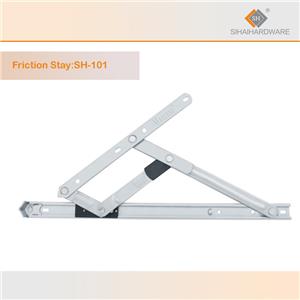
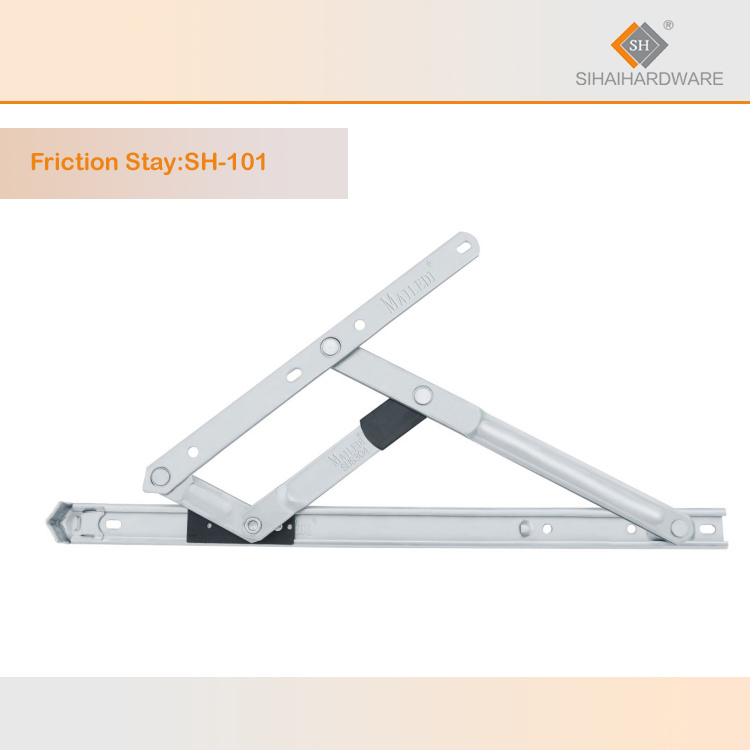
The window friction stay performs an entirely separate function. It does not carry the weight of the sash, nor is it designed to. Its job is controlling the angular position of the sash and resisting the forces that try to move it. When wind strikes an open window, it creates a closing moment. Without a friction stay, the sash swings freely and slams shut. The stay resists this moment through a sliding shoe that travels along a track, generating controlled frictional resistance. A friction pad inside the shoe—typically made of polymer or sintered bronze composite—presses against the stainless steel track with a calibrated force. The user overcomes this friction to open or close the window, and the same friction holds the sash steady when released. Unlike hinge failures, which are often sudden, friction stay degradation is gradual. The pad wears, the spring inside the shoe weakens, and the holding force diminishes cycle by cycle. A failing stay reveals itself through sash drift—the window creeps closed on its own or refuses to stay open at certain positions. This is fundamentally a friction problem, not a structural one.
Why the Distinction Matters for Troubleshooting
Knowing which component does what transforms window troubleshooting from guesswork into a logical process. A sash that has dropped and scrapes the sill is a hinge problem. The hinge has either bent, loosened at its fasteners, or worn through its bearing. Adjusting or replacing the friction stay will accomplish nothing because the stay does not carry vertical load. A sash that opens smoothly but will not hold at the desired angle is a friction stay problem. The hinge is doing its job; the stay has lost its grip. Replacing the hinge in this scenario wastes money and solves nothing. The most confusing case occurs when both problems appear together. A worn hinge allows the sash to sag slightly, which misaligns the friction stay track relative to its sliding shoe. The misaligned stay wears unevenly and fails faster. In this situation, replacing only the stay provides temporary relief, but the underlying hinge wear will destroy the new stay as well. The correct repair sequence addresses the hinge first, restores proper alignment, and then evaluates whether the stay still needs replacement.
The Corner Brace Connection
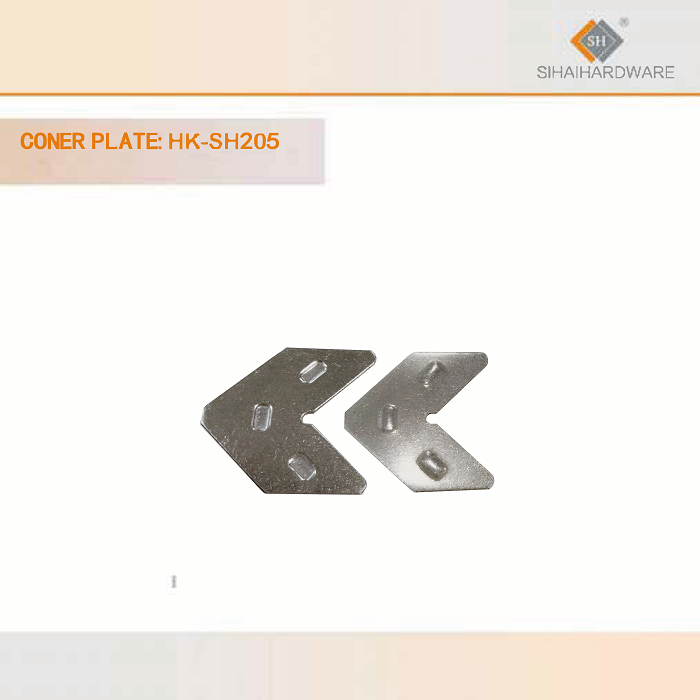
Where hinge loads and friction stay forces meet, the frame corner takes the combined stress. The hinge transfers sash weight into the vertical jamb. The window friction stay transfers wind and holding forces into the horizontal sill or head. Both force paths converge at the corner joint, creating compression, shear, and torsion acting simultaneously. A Corner Brace reinforces this critical intersection. Without adequate corner reinforcement, the frame joint gradually works loose under repeated loading. Fastener holes elongate, the hinge loses its secure anchorage, and the friction stay track shifts out of alignment. A frame that flexes at the corner alters the operating geometry of both hinge and stay, accelerating wear on components that might otherwise have lasted for years. In aluminium window fabrication, corner braces are standard precisely because the mechanical corner joint, while efficient to manufacture, is the weakest link in the structural chain.
Choosing the Right Components
Specifying the correct hinge and friction stay combination means matching both to the actual service conditions. The hinge must be rated for the full sash weight with a safety factor—typically 1.5 to 2.0 for residential use, higher for commercial or high-wind locations. The friction stay must be rated for the closing moment generated by the design wind pressure on the fully open sash. Under-specifying either component creates a predictable failure. A strong hinge with a weak stay produces a window that opens smoothly but slams shut in moderate wind. A strong stay on a weak hinge holds position well but gradually bends the hinge leaves or loosens the fasteners. The Corner Brace specification should account for the combined demands of both, ensuring the frame corner can transfer accumulated forces without deflection. In coastal or high-wind areas, upgrading all three components together—hinge, stay, and corner reinforcement—provides a system that performs reliably rather than a collection of parts that fight each other.
Conclusion
The hinge and the window friction stay are not interchangeable, and they are not alternative solutions to the same problem. The hinge supports weight. The friction stay holds position. Confusing these roles leads to misdiagnosis, wasted parts, and windows that never stay fixed. A dropped sash points to the hinge. A drifting sash points to the stay. When both symptoms appear, look to the frame corner, where a properly specified Corner Brace keeps the entire assembly rigid and aligned. Understanding these three components and their distinct functions turns a frustrating window problem into a straightforward repair.