ARTICLE NO.163 | What Is an Angle Bracket? The L-Shaped Metal Piece That Holds Things Together
ARTICLE NO.163 | What Is an Angle Bracket? The L-Shaped Metal Piece That Holds Things Together
An angle bracket is one of those humble hardware items that rarely attracts attention, yet holds together a surprising amount of the built environment. Shaped like the letter L, it bridges two surfaces meeting at a right angle and transfers loads between them. In timber framing, furniture assembly, shelving, and architectural metalwork, this simple component prevents joints from racking, shelves from sagging, and frames from twisting under load. A Corner Brace is a specific type of angle bracket designed for heavier structural applications, particularly in window and door frame construction where the forces concentrated at frame corners demand reinforcement beyond what the joint alone can provide.
The Basic Geometry
An angle bracket consists of two flat legs joined at a right angle, typically with pre-drilled holes for screws, bolts, or other fasteners. The legs may be equal in length, forming a symmetrical bracket, or unequal when one surface carries more load or offers less mounting area than the other. The material thickness, leg width, and hole pattern all vary according to the intended load and the substrate into which the bracket will be fastened. Despite this apparent simplicity, the geometry of an angle bracket embodies sound structural principles. The right-angle form resists both shear forces that try to slide the connected members past each other and tensile forces that try to pull them apart. The multiple fastener holes along each leg distribute the transferred load across several points rather than concentrating it at a single connection.
How an Angle Bracket Transfers Load
The load path through an angle bracket is more complex than it first appears. When a vertical load presses down on a shelf supported by angle brackets, the load travels from the shelf into the upper leg of the bracket through the fasteners. It then turns the corner through the body of the bracket and transfers into the wall through the fasteners in the lower leg. This load path subjects the bracket to combined bending, shear, and tension. The bend radius—the corner where the two legs meet—is the most highly stressed region of any angle bracket. The metal here must resist the bending moment created by the offset between the line of action of the load and the line of resistance from the wall fasteners. In a well-designed bracket, this corner is reinforced by a gusset, a widened section, or a rib that increases the cross-sectional area and the moment of inertia precisely where the stress peaks.
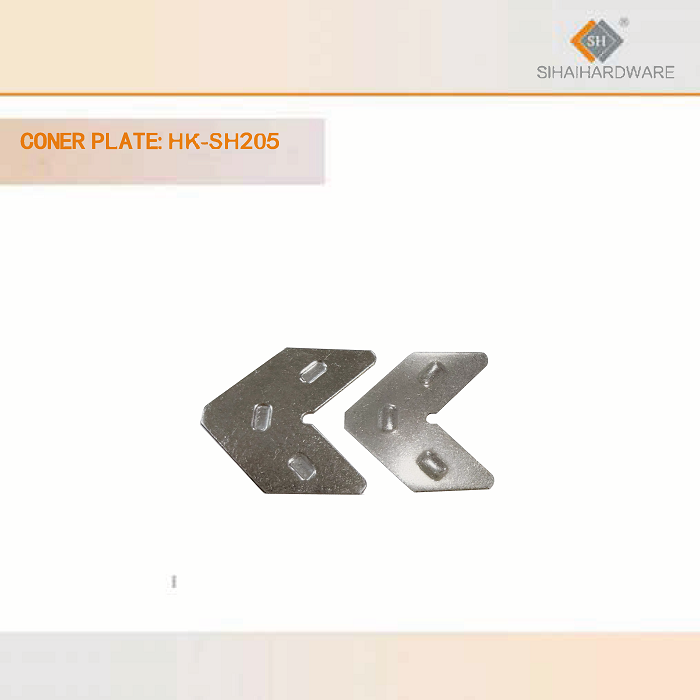
The Corner Brace: A Heavy-Duty Angle Bracket
A Corner Brace is an angle bracket engineered for structural applications where the loads are substantial and the consequences of failure are serious. In window and door frame construction, corner braces reinforce the mitred or butt-joined corners of aluminium, uPVC, or timber frames. The corner joint of a window frame must resist the weight of the glass, the operating forces from opening and closing, and wind loads transferred through the hardware. Without reinforcement, the corner is the weakest point in the frame assembly. A Corner Brace bridges this joint, tying the horizontal and vertical frame members together and distributing the concentrated corner stresses across multiple fasteners into both profiles. The brace is typically manufactured from steel, stainless steel, or high-strength aluminium alloy, with material thickness and leg dimensions matched to the specific frame system.
Material Choices for Angle Brackets
Angle brackets are manufactured from a range of materials, each suited to particular environments and load requirements. Mild steel brackets, typically zinc-plated or powder-coated, provide adequate strength for most interior applications at low cost. Stainless steel brackets, usually grade 304 or 316, are specified where corrosion resistance is essential—in exterior applications, coastal environments, or food preparation areas. Aluminium brackets offer a combination of light weight, corrosion resistance, and compatibility with aluminium framing systems. For extreme loads, brackets may be forged rather than stamped, producing a grain structure that follows the bracket profile and eliminates the stress concentrations associated with punched holes and sharp bend radii. The choice of fastener material is equally important. A stainless steel bracket installed with mild steel screws will fail at the fasteners through galvanic corrosion long before the bracket itself reaches its load limit.
Common Applications
Angle brackets and Corner Brace components appear in a remarkably wide range of applications. In furniture assembly, small pressed-steel angle brackets secure table legs to aprons and shelf panels to side panels. In timber framing, heavy angle brackets connect beams to posts and joists to headers, often in conjunction with through-bolts or structural screws. In architectural metalwork, angle brackets support glass balustrades, canopy frames, and solar shading structures. In window and door fabrication, Corner Braces are inserted into the hollow chambers of extruded profiles to reinforce the mitred corner joints. In each application, the bracket does the same fundamental job: it turns a weak angular connection into a rigid structural node by providing a triangulated load path that the joint alone cannot offer.
Installation and Load Capacity
The load capacity of an angle bracket depends as much on the installation as on the bracket itself. A bracket rated for 100 kilograms can fail at half that load if the screws are undersized, driven into a weak substrate, or over-tightened to the point of stripping the threads. The fasteners must be appropriate for the substrate material—wood screws for timber, machine screws for steel, self-tapping screws for aluminium—and must be driven to the correct depth without damaging the surrounding material. The bracket must sit flat against both surfaces, with no gap that would allow movement under load. In structural applications, the number, size, and spacing of fasteners should follow the manufacturer's specification exactly. Substituting fewer screws or smaller screws to save time or material directly reduces the bracket's capacity.
Signs of Overload or Failure
An angle bracket or Corner Brace that is overloaded or failing provides visible warning signs. The bracket legs may bend or twist, indicating that the bending moment has exceeded the material's yield strength. The fasteners may pull loose from the substrate, leaving enlarged holes or cracked material around the screw locations. In metal frames, a failing Corner Brace may be detectable as a visible gap opening at the corner joint, or as a change in the window or door operation—binding, sagging, or difficulty closing that was not present when the unit was new. Corrosion, particularly at the bend radius or around fastener holes, reduces the effective cross-section and concentrates stress. Any of these signs warrants immediate replacement, as a failed angle bracket can lead to progressive collapse of the assembly it supports.
Conclusion
The angle bracket and its heavy-duty counterpart, the Corner Brace, belong to a category of hardware that works best when it is noticed least. Their function is to make connections rigid, to keep corners square, and to transfer loads from one structural member to another without drawing attention to themselves. The L-shaped metal piece that holds things together represents one of the oldest and most reliable solutions in structural engineering—a triangulated connection that transforms a flexible joint into a rigid node. Whether in a bookshelf or a high-rise curtain wall, the principle remains the same. The bracket that is specified correctly, installed properly, and matched to its environment will continue to perform its quiet structural role for the life of the assembly it serves.