ARTICLE NO.186 | Why a Window Stay With a Heavier Gauge Material Lasts Longer
ARTICLE NO.186 | Why a Window Stay With a Heavier Gauge Material Lasts Longer
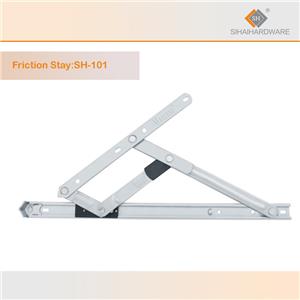
The thickness of the stainless steel in a window friction stay is not simply a matter of how solid the hardware feels in the hand. It is a fundamental engineering parameter that determines how the stay resists bending, how it distributes stress, and how long it will survive under cyclic loading. Two stays that appear identical in design and are manufactured from the same grade of stainless steel can have dramatically different service lives if one uses heavier gauge material. Understanding why thicker material lasts longer reveals the mechanical principles that govern friction stay durability.
The Relationship Between Thickness and Bending Resistance
The resistance of a metal strip to bending is proportional to the cube of its thickness. This means that a small increase in material gauge produces a disproportionately large increase in stiffness. A window friction stay arm manufactured from 2-millimetre stainless steel is not 33 percent stiffer than an arm made from 1.5-millimetre stock—it is more than twice as stiff. This matters because the arms of a friction stay are subjected to bending loads every time the window is opened or closed. A thicker arm deflects less under the same load, maintaining its designed geometry more precisely. A thinner arm flexes more, and this repeated flexing is the mechanism through which fatigue damage accumulates. The thicker arm operates in a regime of lower strain amplitude, which directly translates to a longer fatigue life.
Stress Distribution in Heavier Sections
When a load is applied to a window friction stay component, the stress within the material is not uniform. It concentrates at geometric features—rivet holes, bend radii, and the edges of the track slot. In a heavier gauge component, these stress concentrations are lower in magnitude relative to the material's strength. The thicker cross-section provides more material through which the load can spread before it reaches the critical point. Around a rivet hole, for example, the bearing stress on the hole wall is inversely proportional to the material thickness. A 2-millimetre thick arm distributes the rivet load over twice the bearing area of a 1-millimetre arm, halving the local stress at the point where fatigue cracks are most likely to initiate. This is why heavier gauge stays show less cracking around rivet holes and less elongation of the holes themselves over time.
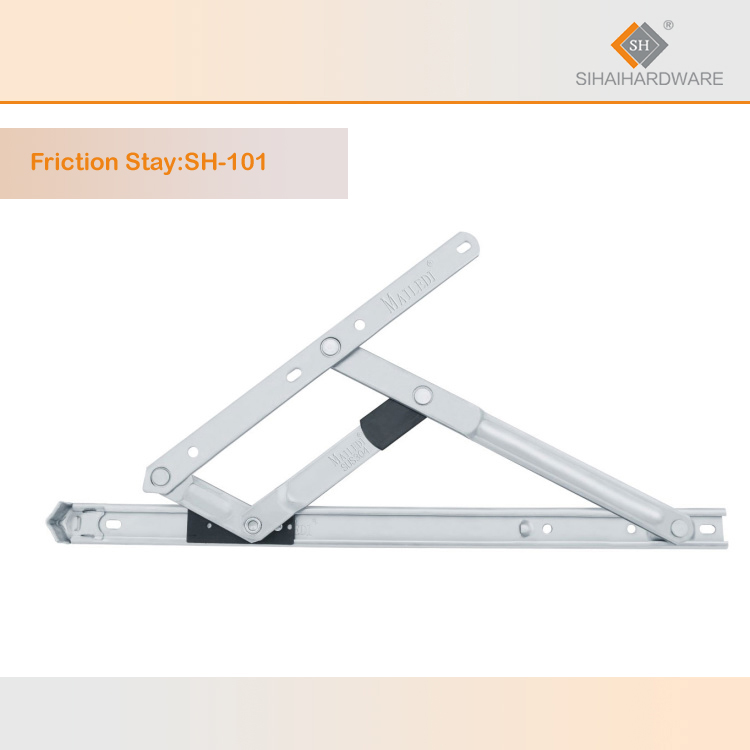
Resistance to Overload Events
Daily use of a window friction stay is not a perfectly controlled laboratory test. The stay is occasionally subjected to overloads—a gust of wind catching the open sash, a user forcing a stiff window, an object striking the window frame. These overload events can bend thin components permanently, and a bent component is a weakened component. Heavier gauge material has a higher yield moment, meaning it can absorb a larger overload without permanent deformation. A stay made from 2-millimetre stock can survive an overload that would permanently bend a 1.5-millimetre stay. This resilience is particularly important in exposed locations where wind loads are high and unpredictable. The heavier stay provides a margin of safety that the thinner stay does not.
Fatigue Life and the S-N Curve
The fatigue life of a metal component is described by an S-N curve, which plots the stress amplitude against the number of cycles to failure. For stainless steel, the curve is relatively flat at low stress amplitudes, meaning that components operating below a certain stress threshold can survive effectively infinite cycles. As the stress amplitude increases, the fatigue life drops rapidly. A window friction stay made from heavier gauge material operates at a lower stress amplitude for any given load. This lower stress amplitude places the component further into the flat region of the S-N curve, where fatigue life is effectively unlimited. The thinner component, operating at a higher stress amplitude, may sit on the steeper portion of the curve, where each increment of stress produces a dramatic reduction in cycle life. The practical result is that a heavier stay may survive hundreds of thousands of cycles, while a thinner stay under the same load may fail after tens of thousands.
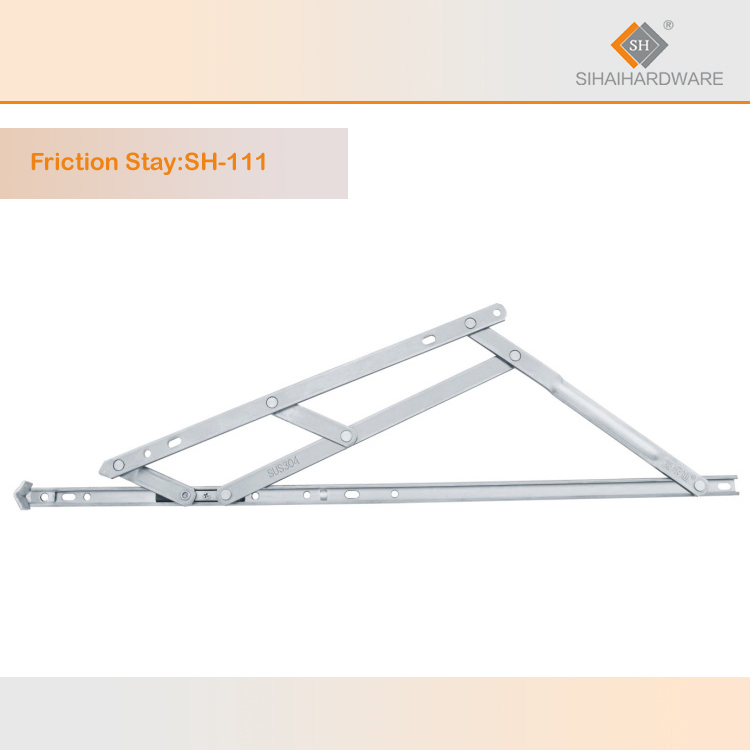
The Trade-Off: Weight and Cost
If heavier gauge material is always better, why are not all window friction stay components manufactured from thick plate? The answer involves weight and cost. Heavier gauge material costs more per unit length, and the additional weight must be supported by the window frame and the hinges. For lightweight sashes and sheltered locations, a thinner stay is perfectly adequate and provides the benefit of lower cost and less strain on the window structure. The engineering challenge is to match the material gauge to the expected loads and the desired service life. A premium stay intended for a heavy triple-glazed sash in an exposed location will use heavier gauge material because the loads and the consequences of failure justify the additional cost. A basic stay for a small interior window can safely use thinner material. The key is that the gauge is selected deliberately, not simply to reduce manufacturing cost at the expense of durability.
Identifying Heavier Gauge Construction
For the purchaser or specifier, identifying whether a window friction stay uses heavier gauge material is not always obvious from a catalogue photograph. The material thickness should be specified in the manufacturer's technical data. A reputable manufacturer will state the gauge of the track, the arms, and the sash bracket. When comparing stays, the gauge of the arms is the most important figure, as the arms experience the highest bending stresses. The track gauge matters as well, particularly for the walls of the slot where the sliding shoe runs. A stay with arms of 1.5 millimetres and a track of 1.2 millimetres is a lightweight design. A stay with arms of 2.5 millimetres and a track of 2 millimetres is a heavy-duty design. The difference in weight, apparent when the two stays are held in the hand, is the tangible expression of the difference in expected service life.
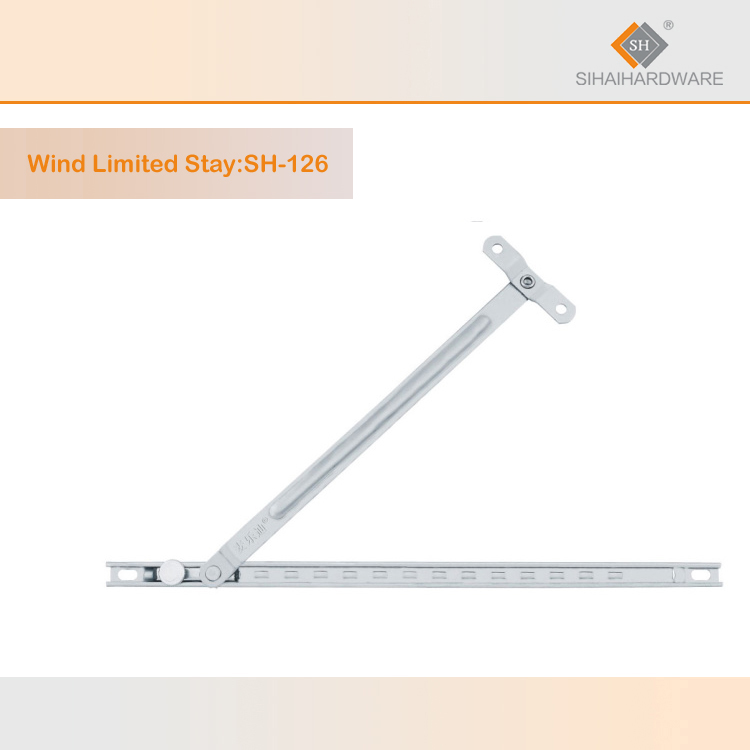
Conclusion
A window friction stay manufactured from heavier gauge stainless steel lasts longer because it operates at lower stress amplitudes, resists overload events more effectively, and distributes concentrated loads over larger areas. The relationship between thickness and bending resistance is cubic, meaning that even a modest increase in gauge produces a substantial increase in stiffness and fatigue resistance. This is not to say that every window needs the heaviest available stay. The correct specification matches the gauge to the application—lightweight stays for light loads, heavy-duty stays for demanding conditions. But when longevity is a priority, and when the window will be subjected to years of daily cycling, the heavier gauge stay is the choice that pays for itself in extended service life and reduced replacement frequency.