ARTICLE NO.121 | The Hidden Part That Takes All the Weight
ARTICLE NO.121 | The Hidden Part That Takes All the Weight
Every time you open a casement window, you trust something you cannot see. You trust that the sash will swing outward without binding. You trust that it will stay where you put it. You trust that it will close tightly against the frame. That trust is placed in a window hinge.
A window hinge is a simple device. Two or four metal arms connect the sash to the frame. Small pins hold the arms together. That is all. But that simplicity hides how much work the hinge actually does.
The Load It Carries
A typical casement window with double glazing weighs between 40 and 70 kilograms. That weight hangs entirely on the window hinge. The hinge must hold that weight not just when the window is closed, but when it is fully open and sticking out from the wall. At that moment, the leverage increases. The force on the hinge is greater than the weight of the sash itself.
If the hinge is weak, the sash will drop. The bottom corner will sag toward the ground. The top corner will pull away from the frame. The window will not close properly. The lock will not engage. The seal will leak.
If the hinge is strong, the sash stays exactly where it should. It opens smoothly. It closes tightly. You never think about it.
Two Designs
There are two common designs for a window hinge. The two-bar hinge uses two arms. It is simple, cheap, and compact. It works well for small windows. But the sash tilts slightly as it opens. The weight is not evenly distributed. Over time, the seal wears unevenly.

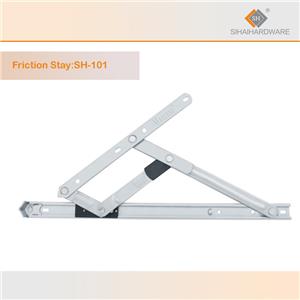
The four-bar hinge uses four arms arranged in a parallelogram. The sash stays parallel to the frame throughout the entire opening. The weight is spread evenly across the hinge. The seal compresses evenly. The window lasts longer. Large windows and commercial buildings almost always use four-bar hinges.
For most residential windows, a four-bar window hinge is the better choice. It costs more, but the difference in performance is significant.
How They Fail
A window hinge fails slowly. The first sign is often a slight resistance when opening. You push harder and the window moves, so you think nothing is wrong. But inside the hinge, the bearings are wearing down. The pins are developing play. The arms are bending.
Corrosion is a common cause of failure. Cheap hinges are made from plated steel. The plating wears off. The steel rusts. The hinge becomes stiff. Eventually it seizes completely. A window hinge made from stainless steel resists rust and lasts much longer.
Bending happens when the hinge is too weak for the sash weight. The arms deform under the load. You cannot see the bend, but the window will not close properly. The sash rubs against the frame. The lock does not engage.
Wear is inevitable. Even the best window hinge will eventually wear out. The metal surfaces become rough. The bearings lose their smoothness. The hinge that once moved with a fingertip now requires force.
Signs You Have a Problem
Most people ignore the early signs of a failing window hinge. They push harder. They lift the sash as they close it. They adapt. But the signs are there.
The window is harder to open than it used to be. You feel resistance that was not there before.
The sash sags when open. Look at the gap between the sash and the frame at the top and bottom. If the gaps are different, the hinge is sagging.
The window makes noise. Squeaking or grinding means metal is scraping against metal. The hinge is wearing out.
You see rust on the hinge or the frame. The metal is corroding. It will only get worse.
The window does not close fully. There is a gap between the sash and the frame. Air and water can get through.
If you see any of these signs, your window hinge needs attention.
What You Can Do
Some problems can be fixed with adjustment. Many window hinges have adjustment screws that move the sash up, down, left, or right by a few millimeters. A small turn of a screw can fix a sagging sash or a gap at the seal. This takes a few minutes.
Lubrication can help if the hinge is stiff but not damaged. Use silicone spray or light oil on the pivot points. Do not use WD-40. It is not a lubricant. It will work for a few days and then the problem will return.
Replacement is necessary if the hinge is bent, corroded, or worn beyond adjustment. You must buy a window hinge that matches the old one. Measure the old hinge or take it to a hardware store. Removing the old hinge requires taking the sash off the frame. This is a two-person job for a large window. The sash is heavy. One slip can break the glass or hurt someone.
If you are unsure, call a professional. A window technician can diagnose the problem in minutes and replace a window hinge in less than an hour.
Choosing a New Hinge
When you buy a replacement window hinge, choose carefully. Stainless steel hinges cost more but last much longer than plated steel. For coastal areas, choose marine-grade stainless steel.
The hinge must be the correct size. Measure the length, width, and stack height of the old hinge. If you buy the wrong size, the window will not close properly.
The load rating must be high enough for your sash weight. A hinge rated for 50 kilograms will fail on a 70 kilogram sash. Buy a hinge rated for more than your window weighs.
If your old hinge was a two-bar hinge, consider upgrading to a four-bar window hinge. It will perform better and last longer.
The Cost of Waiting
People wait too long to fix window hinge problems. They push harder. They lift the sash. They live with the annoyance. The problem gets worse.
A hinge that is slightly worn today will be badly worn next year. The metal will continue to wear. The corrosion will continue to spread. The bend will become more pronounced. By the time you finally fix it, the hinge may have damaged the frame, the seal, or the lock.
The cost of waiting is not just the repair. It is the frustration of using a window that fights you every day. It is the draft that makes the room cold. It is the water stain on the sill. It is the lock that never quite catches.
A window hinge replacement costs a fraction of what a new window costs. Fix it now, while it is still a small job.
Conclusion
The window hinge is the part you never see. It is hidden between the sash and the frame. It carries the weight of the entire window. It allows smooth operation thousands of times. When it works, you never think about it. When it fails, you cannot ignore it.
Pay attention to the signs. Difficulty opening. Sagging. Noise. Rust. Gaps. These are warnings. The window hinge is telling you it needs help.
Do not wait. Adjust it. Lubricate it. Replace it if you need to. Call a professional if you are unsure.
A good window hinge opens smoothly, closes tightly, and asks for nothing. That is what it is supposed to do.