ARTICLE NO.171 | The Static Load Capacity of a Window Stay vs. Its Dynamic Load Capacity Under Wind Gusts
ARTICLE NO.171 | The Static Load Capacity of a Window Stay vs. Its Dynamic Load Capacity Under Wind Gusts
A window friction stay is rated to hold a sash of a certain weight at a certain opening angle. This rating, typically expressed in kilograms, appears straightforward. A stay rated for 20 kilograms should hold a 20-kilogram sash. But this number represents static load capacity—the ability to support a stationary sash under calm conditions. The real world is rarely calm. Wind gusts impose loads that are fundamentally different from the steady weight of the sash, and a stay that is perfectly adequate under static conditions can fail dramatically when subjected to the dynamic forces of a storm. Understanding the distinction between these two loading regimes is essential for anyone who specifies, installs, or relies on friction stay hardware.
What Static Load Capacity Means
The static load capacity of a window friction stay is determined by a standardised test in which a calibrated weight is hung from the stay at a specified distance from the hinge axis, simulating the moment created by a sash of known mass. The stay must hold this weight without slipping, and the sliding shoe must not move from its set position. This test measures the pure holding force generated by the friction pad pressed against the track. It is a useful baseline because it confirms that the stay can support the sash under ideal conditions—no wind, no vibration, no sudden movements. The static rating provides the minimum performance that any stay of that specification must meet. It does not, however, tell the full story of how the stay will behave when nature intervenes.
What Dynamic Loading Means
Dynamic loading on a window friction stay occurs when wind gusts strike the open sash. Unlike the steady downward pull of gravity, wind loads are variable in both magnitude and direction. A gust can strike the sash from the outside, pushing it toward closure, or from an oblique angle, creating a twisting force. The load rises rapidly—often from zero to peak force in less than a second—and then decays just as quickly as the gust passes. The stay does not experience a constant force against which it can brace. It experiences a rapid series of force pulses, each testing the friction pad's ability to resist movement under suddenly applied loads. This is a fundamentally different mechanical challenge from static holding. A friction pad that grips securely under a gradually applied load may slip when the same load is applied suddenly, because the static friction coefficient between the pad and track can be overcome by the momentum of the accelerating sash.
The Momentum Problem
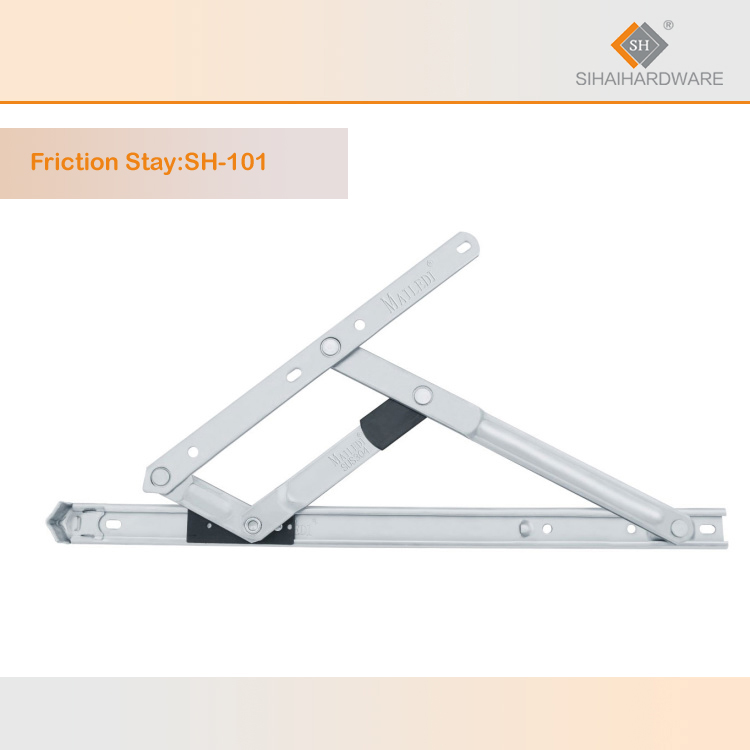
The critical difference between static and dynamic loading on a window friction stay involves momentum. Under static conditions, the only force the stay must resist is the gravitational pull on the sash mass. Under dynamic conditions, the wind accelerates the sash, giving it momentum. The stay must now resist not just the wind force but also the kinetic energy that the sash has accumulated during the gust. A sash that has been accelerated through even a small angle carries momentum that must be absorbed by the friction pad. If the pad cannot absorb this energy quickly enough, the sash continues to move, building more momentum as it goes. The stay can enter a condition where the friction pad, once overcome, cannot regain its grip because the sliding shoe is now moving too fast for the pad to re-establish static friction. The sash then slams shut, regardless of the stay's static rating. This is why a stay that holds perfectly during calm weather can fail dramatically during a storm—the dynamic loading regime is fundamentally more demanding than the static test that produced the rating.
How Manufacturers Address the Difference
Premium window friction stay manufacturers account for the difference between static and dynamic loading through design features that are not captured by the basic static rating. The friction pad material is selected not just for its static friction coefficient but for its dynamic friction characteristics—its ability to maintain grip under suddenly applied loads without entering a slip condition. The pad surface may be textured or grooved to improve dynamic response. The spring mechanism that presses the pad against the track may incorporate damping elements that resist rapid movement. Some stays include a separate check mechanism that engages only under dynamic conditions, providing additional resistance that is not needed for static holding. These features add cost and complexity, which is why they appear on higher-specification stays. The static rating alone does not distinguish between a stay with these dynamic-load features and one without them.
The Role of the Secondary Arm
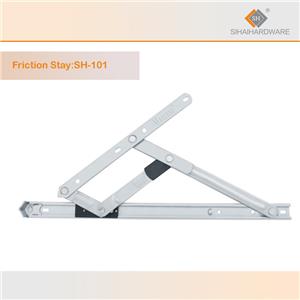
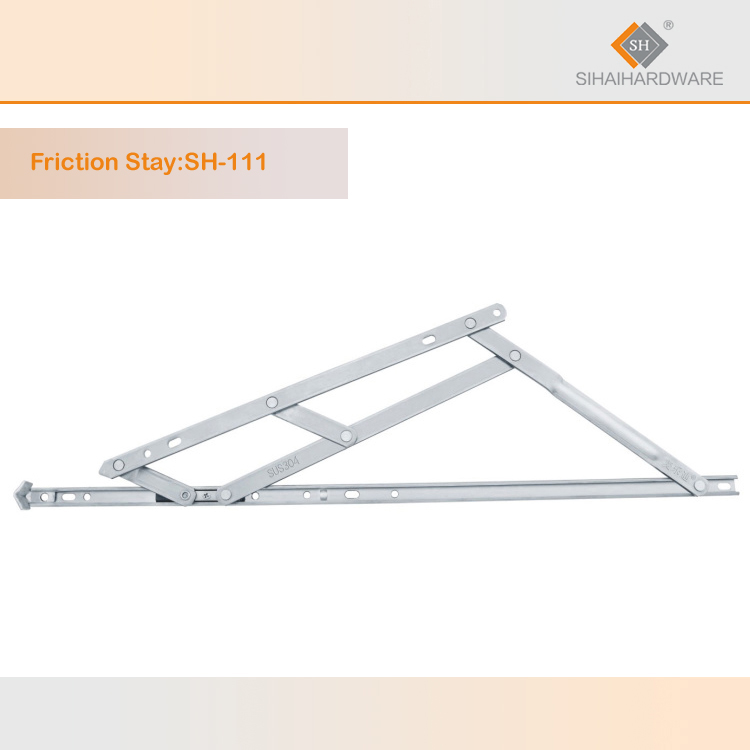
The secondary stabilising arm found on some window friction stay designs plays a specific role in dynamic load resistance. Under a sudden wind gust, the sash experiences not just a closing force but a twisting moment that tries to rotate it relative to the frame. In a single-arm stay, this twisting is resisted only by the friction pad's grip on the track and the single connecting arm's attachment to the sash bracket. A dual-arm stay provides a second load path that resists this twisting motion directly, through the mechanical constraint of the linkage geometry rather than through friction alone. The secondary arm does not increase the static load rating of the stay—the static test only measures holding force, which is determined by the friction pad. What it does is improve the stay's ability to maintain control of the sash under the complex, multi-directional forces of a wind gust. This is a dynamic load improvement that a static rating does not reveal.
Specification Implications
Selecting a window friction stay based solely on its static load rating is like choosing a car based solely on its top speed. The number tells you something useful, but it does not tell you how the vehicle will handle in a corner or stop in an emergency. For windows in sheltered, low-rise locations, the static rating may be sufficient guidance. The wind loads are moderate, and the difference between static and dynamic capacity is unlikely to be tested. For windows in exposed locations, upper floors, coastal areas, or any site subject to strong or gusty winds, the static rating alone is not enough. The specifier should look for stays that have been tested under dynamic conditions, that incorporate design features specifically intended for dynamic load resistance, and that are rated by manufacturers who can provide performance data beyond the basic static kilogram number.
Conclusion
The static load capacity of a window friction stay is a necessary but insufficient measure of its real-world performance. It confirms that the stay can hold the sash under ideal conditions. It does not confirm that the stay can survive a storm. The dynamic loads imposed by wind gusts—rapidly applied, variable in direction, and carrying the momentum of an accelerated sash—represent a fundamentally more demanding condition than the steady pull of gravity. A stay that is specified, installed, and trusted based on its static rating alone may fail when it is needed most: when the wind is blowing hard, the sash is open, and the stay is the only thing preventing a heavy glass panel from slamming shut with destructive force. Understanding the difference between static and dynamic capacity is the first step toward selecting hardware that performs not just in the test laboratory, but in the real weather that real windows must endure.