ARTICLE NO.151 | How Dust and Dirt Slowly Kill Your Window Handle's Smooth Operation
ARTICLE NO.151 | How Dust and Dirt Slowly Kill Your Window Handle's Smooth Operation
The window handle is touched thousands of times over its service life. Each turn of the lever engages a precise sequence of mechanical movements—the spindle rotates, the locking points retract, the sash releases from its seals. When the handle operates smoothly, this sequence is so effortless that users never think about it. When it becomes stiff, gritty, or resistant, the entire experience of using the window deteriorates. The most common cause of this gradual decline is not a manufacturing defect or a material failure. It is the slow, relentless accumulation of dust and dirt inside the mechanism. Understanding how these tiny particles infiltrate, where they settle, and what damage they cause reveals why regular cleaning is not optional for long-term handle performance.
How Particles Get Inside
A window handle appears well-sealed from the outside. The rose plate sits flush against the frame, the lever emerges through a close-fitting aperture, and the entire assembly seems impervious to contamination. In reality, the clearance between the rotating lever and the stationary escutcheon—often just a fraction of a millimetre—is an open doorway for airborne particles. Every time a window is opened for ventilation, the airflow through the room carries dust past the handle. Temperature differences between indoors and outdoors create convection currents that draw air through these small gaps. Over months and years, the particles that settle on visible surfaces are only a fraction of what enters the mechanism. The finest dust—particles smaller than 10 microns—penetrates deepest, working its way into the spindle bore and the spring housing where clearance is measured in hundredths of a millimetre.
Where Particles Settle
Inside a handle, dust and dirt do not distribute evenly. They concentrate at specific locations determined by gravity, airflow, and the movement of internal components. The lowest point of the rose housing becomes a collection basin for heavier particles that fall out of suspension. The interface between the spindle and its bearing surface accumulates fine dust that is drawn into the narrow gap by capillary action when humidity creates a thin moisture film. The return spring cavity traps particles that are carried in by the spring's own movement—each compression cycle acts as a tiny bellows, drawing air and suspended particles into the housing. The most damaging accumulation occurs at the contact point between the handle stop and its abutment, where repeated impact grinds trapped particles into the metal surfaces.

Abrasive Wear on Bearing Surfaces
The spindle of a handle rotates within a bearing surface every time the window is opened or closed. In a clean handle, the spindle and bearing are separated by a thin lubricant film that prevents metal-to-metal contact. When dust particles enter this interface, they become embedded in the softer of the two surfaces—typically the zinc alloy or aluminium housing rather than the hardened steel spindle. Once embedded, these particles act as micro-cutting tools. Each rotation of the spindle drags the embedded particles across the opposing surface, creating fine scratches that progressively deepen. The surface roughness of the bearing increases, which in turn traps more particles. The lubricant becomes contaminated with wear debris, forming an abrasive paste that accelerates the damage. What began as a barely perceptible roughness in handle operation becomes, over thousands of cycles, a distinct gritty sensation that users describe as a handle feeling "rough" or "sandy."
Spring Degradation from Contamination
The return spring inside a handle is particularly vulnerable to particulate contamination. The spring operates in a confined space, and its coils move relative to each other with each handle cycle. Dust particles that settle between the coils create point contact stresses when the spring compresses. These localised stress concentrations can initiate surface cracks on the spring wire, particularly if the particles are hard and angular—quartz grains from windblown sand are especially damaging. The particles also absorb and displace the lubricant that protects the spring from corrosion. A spring that operates in a contaminated environment loses its protective film faster than one in a sealed, clean assembly. The combined effects of abrasion, corrosion, and reduced lubrication cause the spring to lose tension gradually. The handle no longer returns crisply to its horizontal rest position. It begins to droop, requiring manual repositioning after each use.
The Escutcheon Gap: A Wear Accelerator
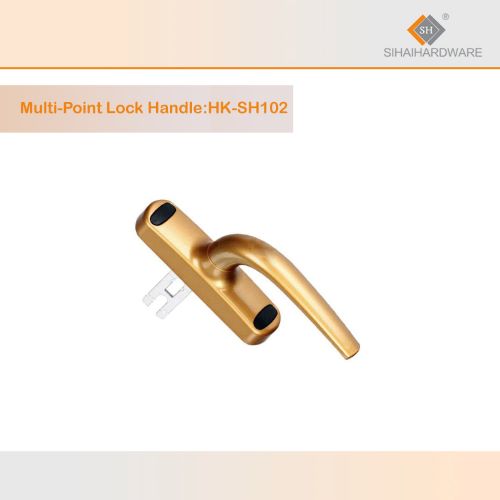
The gap between the handle lever and its escutcheon is unavoidable from a manufacturing perspective. The lever must rotate freely, and the clearance provides tolerance for thermal expansion and minor misalignment. However, this gap also functions as a grinding zone. Dust particles that settle on the escutcheon surface are drawn into the gap by the lever's rotation. The particles become trapped between the lever neck and the escutcheon edge, where they are subjected to repeated crushing and shearing as the lever turns. This process produces two forms of damage simultaneously. The particles abrade the finish on both the lever and the escutcheon, creating visible wear rings around the lever base. They also generate additional fine particles as they are pulverised, increasing the total contaminant load inside the mechanism. A handle that has operated in a dusty environment for several years will often show a distinct wear groove on the lever neck, corresponding exactly to the plane of rotation where the escutcheon gap is narrowest.
Environmental Factors That Accelerate Contamination
Certain environments dramatically accelerate the rate at which a handle accumulates damaging dust. Coastal properties face a double challenge: windblown salt crystals mixed with sand create an abrasive slurry when combined with humidity. The salt is hygroscopic, attracting moisture that keeps the internal components damp and promotes corrosion alongside abrasive wear. Buildings near construction sites or unpaved roads experience elevated levels of silica dust, which is particularly hard and angular. Industrial areas introduce metallic particles and chemical dusts that can react with the handle's finish or lubricant. Kitchens and bathrooms within the building present their own challenges: cooking oils and soap residues mix with dust to form sticky deposits that resist normal cleaning and trap additional particles. Handles in these environments require more frequent maintenance than those in clean, climate-controlled interior spaces.

The Maintenance Solution
Preventing dust-related deterioration of a handle does not require specialised equipment or frequent disassembly. A simple cleaning routine, performed annually or semi-annually depending on the environment, can extend the handle's smooth operation significantly. The external surfaces should be wiped with a soft, dry cloth to remove loose dust before it can migrate into the mechanism. The gap between the lever and escutcheon can be cleaned with a small, soft-bristled brush—an old toothbrush is ideal—to dislodge particles without scratching the finish. A brief spray of compressed air directed into the lever gap can expel loose particles from the spindle area. After cleaning, a light application of appropriate lubricant—a dry PTFE spray for dusty environments, or a light machine oil for cleaner conditions—restores the protective film on bearing surfaces. The lubricant should be applied sparingly; excess lubricant acts as a dust magnet and defeats the purpose of the cleaning.
When Cleaning Is No Longer Enough
A handle that has accumulated years of compacted dust and wear debris may not respond to external cleaning. The particles have become so thoroughly embedded in bearing surfaces and so densely packed in internal cavities that surface treatment cannot reach them. The handle exhibits symptoms that indicate this advanced stage of contamination: a persistent gritty feel that cleaning does not improve, a lever that fails to return to its rest position even after lubrication, or visible scoring on the spindle visible when the handle is removed. At this stage, disassembly and thorough internal cleaning may restore function, but the cost of labour often exceeds the cost of a replacement handle. If the bearing surfaces have been deeply scored, replacement is the only reliable solution.
Conclusion
The smooth operation of a window handle is not a permanent condition. It is a temporary state that dust and dirt are constantly working to undermine. Every airborne particle that settles near the lever gap is a potential abrasive waiting to be drawn into the mechanism. The damage accumulates slowly, cycle by cycle, until the handle that once operated with a light touch becomes stiff, gritty, and unreliable. The solution is simple: regular cleaning that removes particles before they can embed, and periodic lubrication that maintains the protective film on internal bearing surfaces. A handle that receives this basic care will continue to operate smoothly for years after an identical handle in the same building, installed at the same time but never cleaned, has become rough and resistant. The difference is not in the hardware. It is in the attention paid to the invisible accumulation that quietly destroys smooth operation from the inside.