ARTICLE NO.150 | How Many Rivets Does a Good Window Stay Need? Counting the Strong Points
ARTICLE NO.150 | How Many Rivets Does a Good Window Stay Need? Counting the Strong Points
The rivets in a window friction stay are easy to overlook. They are small, unadorned, and look much the same whether they are holding together a premium stainless steel assembly or a budget imitation. Yet the number of rivets, their placement, and their material quality tell a detailed engineering story about how the stay was designed to perform and how long it can be expected to last. Counting rivets is not a matter of more being automatically better, but understanding why each one exists reveals what separates a durable stay from one that will loosen and fail within a few seasons.
The Primary Pivot: Where It All Begins
Every window friction stay has at least one rivet that matters more than all the others combined: the primary pivot connecting the main arm to the sliding shoe. This single rivet transfers the entire holding force from the friction pad to the sash, and it does so while rotating through an arc of up to 90 degrees with every window cycle. The load on this rivet is not static. As the window opens and closes, the force direction reverses, and the rivet shank experiences cyclic shear loading that can initiate fatigue cracks if the material or installation is substandard. A quality stay uses a solid stainless steel rivet at this location, properly set to fill the hole completely and create a residual clamping force that prevents the joined layers from working loose. Budget stays often substitute a hollow rivet or an undersized fastener that leaves clearance in the hole. That clearance becomes play within a few thousand cycles, and the play accelerates wear on the friction pad, the track, and the rivet itself.
The Track Anchorage: Holding the System Down
The track of a window friction stay is secured to the window frame by screws, not rivets, but the internal assembly of the track often relies on riveted connections. The end stops that prevent the sliding shoe from running off the track are frequently riveted in place. These stops absorb the impact of the shoe at both ends of its travel—every time the window is opened fully or closed completely. A stay with no riveted end stops, or with stops formed simply by crimping the track edges, lacks the structural redundancy to survive years of these impacts. Quality designs rivet a hardened steel stop block at each end of the track. The rivets securing these blocks are loaded in shear each time the shoe hits the stop, and they must resist loosening under vibration. Two rivets per stop block, rather than one, prevent the block from rotating under impact and distributing the load over a single fastener.
The Sash Bracket: Where Geometry Gets Complex
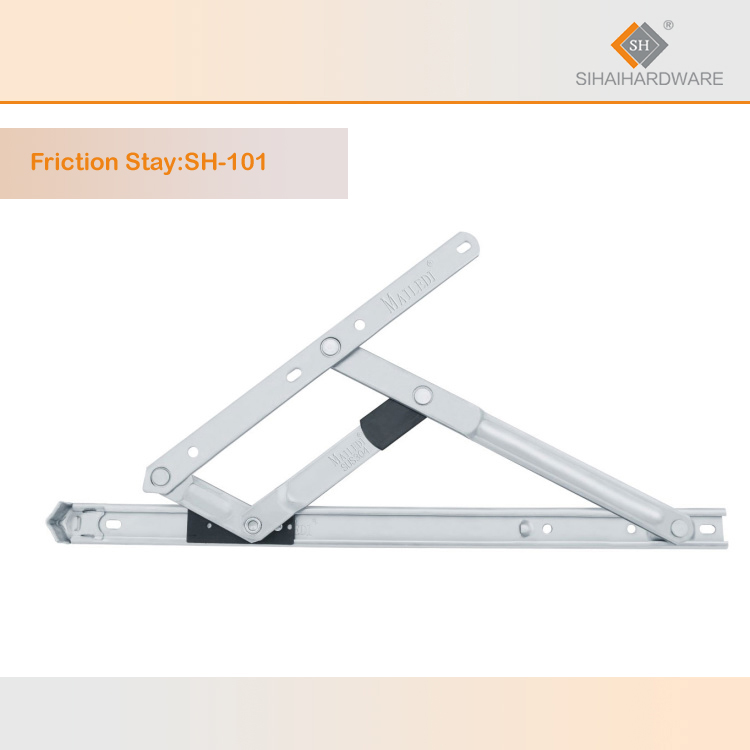
The sash bracket of a window friction stay connects the arm assembly to the moving window sash. This bracket typically requires multiple rivets because it operates at the most geometrically complex point in the entire linkage. The bracket must transfer forces between the main arm, any secondary stabilising arm, and the sash itself, all while maintaining precise angular alignment. A sash bracket with only two rivets has a single line of fastening, which creates a hinge line about which the bracket can flex. Under repeated loading, this flexing works the rivets loose. Adding a third rivet, offset from the line of the first two, creates a triangulated fastening pattern that resists rotation and distributes shear forces more evenly. Premium stays typically use three or four rivets on the sash bracket, arranged to create overlapping triangles of constraint that lock the bracket geometry rigidly in place.
The Secondary Arm: Necessary Redundancy
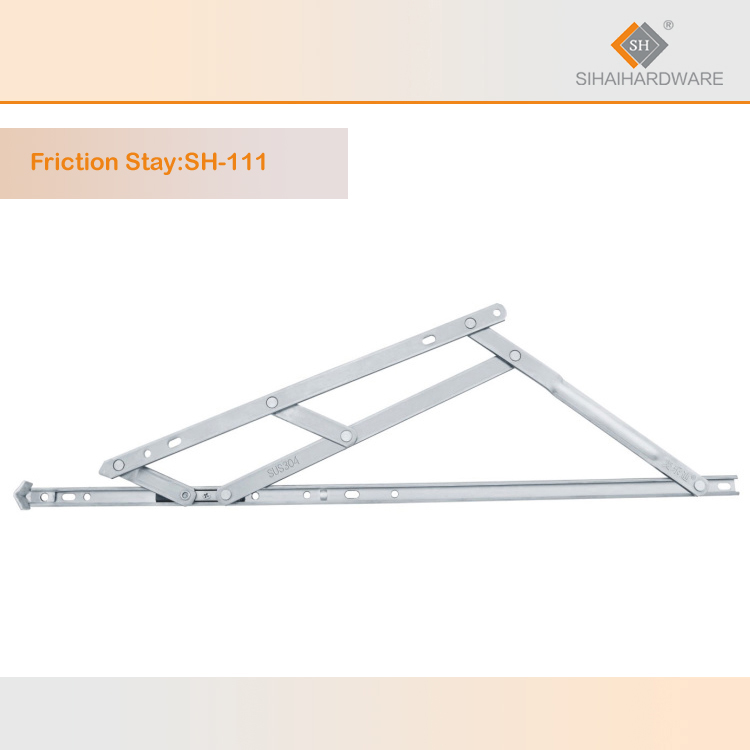
Many window friction stay designs incorporate a secondary stabilising arm that runs parallel to the main connecting arm. This secondary arm requires its own set of rivets, both at the sash bracket and at the sliding shoe. The presence of these additional rivets is a strong indicator of design quality. A single-arm stay relies entirely on one rivet at each end to maintain the sash angle. If either rivet loosens, the sash can tilt and bind. A dual-arm stay distributes the stabilising function across two parallel load paths. If one rivet begins to loosen, the second arm maintains alignment long enough for the problem to be detected during routine maintenance. The secondary arm rivets are typically smaller than the primary pivot rivet, but their number and placement are equally deliberate. Four additional rivets—two at the sash bracket and two at the shoe—represent a significant manufacturing cost increase over a single-arm design, which is why they appear only on stays engineered for longer service life.
Rivet Material and Setting Quality
The number of rivets in a window friction stay counts for little if the rivets themselves are poorly made or incorrectly set. Quality stays use austenitic stainless steel rivets, grade 304 or 316, which match the corrosion resistance of the surrounding components. The rivet setting process must create a tight fill of the hole and a controlled amount of tail deformation to generate the designed clamping force. Under-set rivets leave a gap between the joined layers, which permits relative movement and fretting wear. Over-set rivets crack the tail or distort the surrounding metal, creating stress concentrations that become fatigue initiation points. A properly set rivet shows a symmetrical, dome-shaped tail with no radial cracks, and the joined layers are in full contact around the rivet circumference. These quality indicators are visible on close inspection and provide a reliable guide to the manufacturing standards applied to the entire stay assembly.
Counting Rivets on a Quality Stay
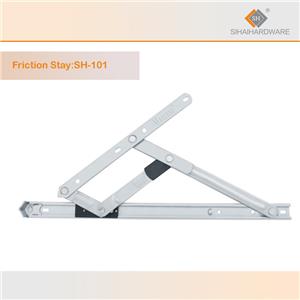
A well-engineered window friction stay intended for a standard residential casement window typically contains between eight and twelve rivets. The primary pivot at the shoe accounts for one. The sash bracket carries three or four, depending on the arm configuration. The secondary arm adds four more. The track end stops contribute two to four, depending on whether each stop uses one or two rivets. A stay with fewer than six rivets in total is likely a single-arm design with minimal end-stop provision, adequate for lightweight, low-cycle applications but not for a window expected to perform daily for decades. A stay with twelve or more well-placed rivets reflects a design philosophy that has identified every point of relative motion in the assembly and constrained it with a dedicated, properly specified fastener.
When Rivets Indicate Trouble
Missing rivets are an obvious warning sign, but more subtle rivet problems are equally telling. A window friction stay that shows rust staining around rivet heads has crevice corrosion developing in the joint. The rivet itself may be a lower grade of stainless steel than the arms and track, creating a galvanic couple that accelerates corrosion. A rivet that sits proud of the surrounding surface, rather than flush, indicates poor setting during manufacture. A rivet that can be rotated by gripping the tail with pliers has lost its clamping force and is no longer performing its structural function. Any of these conditions justifies replacement of the entire stay, because rivet failure is rarely isolated. The same manufacturing shortcuts that produced one bad rivet likely affected every rivet in the assembly.
The Cost of a Rivet
The decision to add one more rivet to a window friction stay design is not trivial for a manufacturer. Each additional rivet requires a hole to be punched, a rivet to be fed and set, and a quality control check to verify correct installation. Across production volumes of hundreds of thousands of units, these costs accumulate. The presence of those extra rivets on a stay is therefore a reliable signal of engineering priority. The manufacturer chose to spend money on fasteners that most customers will never count or notice, because the engineering team understood that those hidden rivets determine whether the stay remains rigid through years of cyclic loading. For the specifier or the building owner, counting rivets offers a simple, visual method of assessing hardware quality before installation, without relying on brand reputation or marketing claims.
Conclusion
The rivets in a window friction stay are a map of the designer's intentions. A stay with the minimum number of rivets was designed to meet a price point. A stay with rivets at every point of load transfer and geometric constraint was designed to outlast the window it serves. Counting them takes seconds. A quality residential stay will have eight to twelve rivets, each set flush and showing no signs of corrosion or movement. Fewer than six, or rivets that look inconsistent in size or finish, suggest a component that will loosen and degrade prematurely. The rivets tell the truth about the stay because they are too small and too numerous for marketing departments to feature. They are there for the engineers, and for anyone who knows to look.