ARTICLE NO.174 | How Corrosion Products Accelerate Friction and Wear in Stainless Steel Stays
ARTICLE NO.174 | How Corrosion Products Accelerate Friction and Wear in Stainless Steel Stays
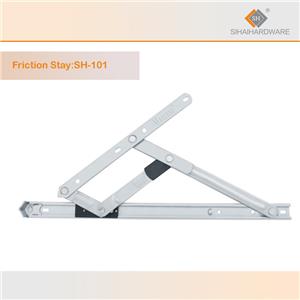
Stainless steel is chosen for a window friction stay precisely because it resists corrosion. The chromium oxide layer that forms spontaneously on its surface protects the underlying metal from the oxidation that rapidly degrades ordinary steel. Yet stainless steel is not immune to corrosion, and when it does corrode, the products of that corrosion become agents of accelerated wear. The very substances that signal corrosion has begun—the rough, discoloured patches on the track, the orange staining around rivet heads—are not passive indicators of damage. They are active participants in a self-reinforcing cycle that increases friction, concentrates stress, and progressively destroys the precision surfaces on which the stay depends.
What Corrosion Products Actually Are
Corrosion products on a window friction stay are not simply rust, although they may resemble it. On stainless steel, the most common corrosion product is iron oxide, formed when the protective chromium oxide layer is breached and the iron in the alloy reacts with oxygen and moisture. In coastal or de-icing salt environments, chloride ions attack the passive layer and produce iron chlorides, which hydrolyse into hydrochloric acid and iron oxides. The resulting corrosion products are chemically complex, physically rough, and volumetrically expansive. They occupy six to ten times the volume of the metal from which they formed. This expansion is a critical fact. A tiny pit in the track surface, invisible to casual inspection, produces a corrosion product bloom that stands proud of the surface, creating an obstacle that the sliding shoe must ride over with each cycle.
How Corrosion Products Increase Friction
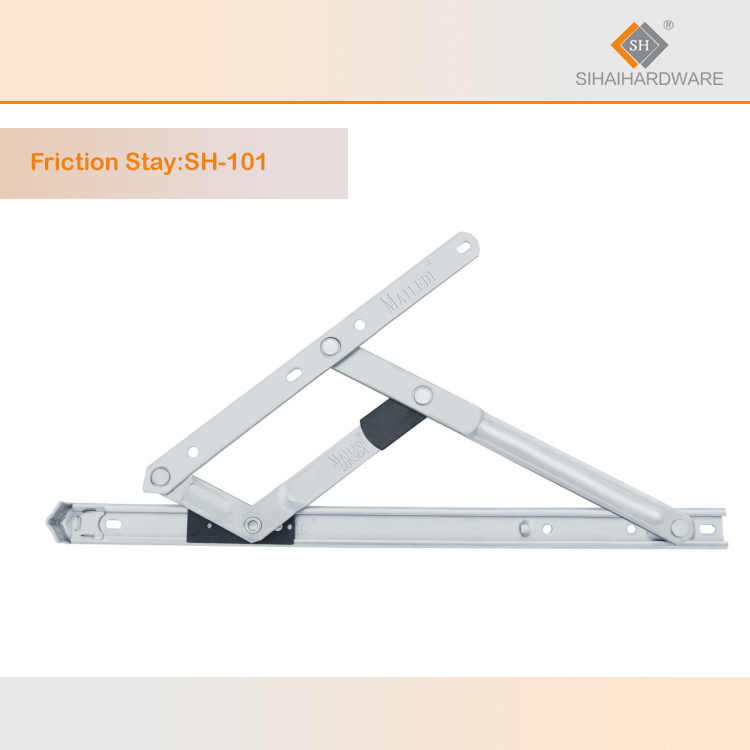
The track of a window friction stay relies on a smooth surface to maintain consistent, predictable friction. The sliding shoe, with its friction pad, is designed to move across a polished stainless steel surface with a specific roughness typically measured in fractions of a micron. Corrosion products disrupt this surface in two ways. First, they are physically rough—the granular, crystalline structure of iron oxides creates a surface texture far coarser than the engineered finish of the track. The friction pad, designed to slide against polished steel, now slides against a surface resembling fine sandpaper. The friction coefficient increases, sometimes dramatically, and the smooth, controlled resistance that characterises a healthy stay degrades into jerky, unpredictable movement. Second, corrosion products are friable—they crumble and fracture under the pressure of the passing shoe, generating loose, hard particles that act as a grinding compound between the pad and the track.
The Third-Body Abrasion Cycle
The loose particles generated as corrosion products fracture become third-body abrasives in the window friction stay mechanism. These particles, composed of hard iron oxides, become trapped between the friction pad and the track. Some embed in the softer of the two surfaces—typically the polymer or composite friction pad. Once embedded, they act as micro-cutting tools, scoring the track with each pass. Others roll between the surfaces, creating indentations that become initiation sites for further corrosion. The process is self-reinforcing. Corrosion roughens the surface, which increases friction, which generates more debris, which accelerates wear, which exposes fresh metal, which corrodes further. This positive feedback loop can destroy a friction stay in a fraction of the time that mechanical wear alone would require.
Crevice Corrosion at Rivet Joints
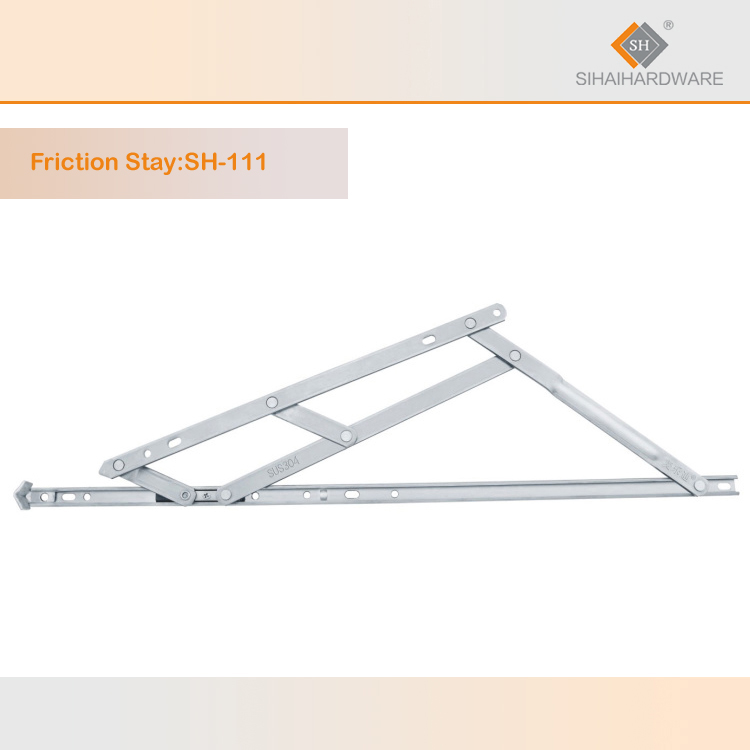
The riveted joints of a window friction stay are particularly vulnerable to a form of corrosion that directly attacks the structural integrity of the assembly. Crevice corrosion occurs in the narrow gap between the rivet shank and the hole wall, where oxygen is quickly depleted and the local chemistry becomes acidic. The corrosion products that form in this crevice are constrained by the surrounding metal. As they expand, they exert a wedging force that can physically push the rivet head away from the surface or separate the layers of metal that the rivet is supposed to clamp together. This is not wear in the conventional sense. It is corrosion acting as a mechanical jack, loosening the joint from within. The resulting play in the rivet connection then accelerates the mechanical wear processes described above, compounding the damage.
Galvanic Acceleration
Budget window friction stay designs sometimes use rivets of a different stainless steel grade than the arms and track. When two stainless steels of different electrochemical potential are in contact in the presence of moisture, a galvanic cell is established. The less noble metal corrodes preferentially. The corrosion products from this galvanic action accumulate precisely at the most highly stressed points in the assembly—the rivet joints—where they act both as abrasive contaminants and as expanding wedges. The galvanic effect is particularly aggressive in coastal environments where the electrolyte is a concentrated salt solution. A stay that would perform adequately in an inland installation can fail within two to three years when installed within sight of the ocean.
Prevention Through Material Selection
Preventing corrosion-accelerated wear in a window friction stay begins with material selection. Marine-grade 316 stainless steel, with its molybdenum content of 2 to 2.5 percent, offers significantly better resistance to pitting and crevice corrosion than standard 304 grade. For coastal installations, specifying 316 for all components—track, arms, rivets, and fasteners—eliminates the galvanic couples that drive accelerated corrosion. The additional material cost is modest compared to the cost of replacing a failed stay in a coastal property, where access may require scaffolding and the replacement window hardware must itself be of marine grade. Passivation of all stainless steel components after manufacturing removes surface iron contamination and enhances the formation of the protective chromium oxide layer.
Maintenance in Corrosive Environments
For window friction stay installations in environments where corrosion risk cannot be eliminated by material selection alone, maintenance becomes the primary defence. Regular cleaning with fresh water removes chloride deposits before they can concentrate and initiate pitting. A light application of a corrosion-inhibiting lubricant creates a barrier film that excludes moisture from the track surface and rivet joints. Inspection at intervals appropriate to the exposure level—quarterly for severe marine environments, annually for less aggressive conditions—allows early detection of corrosion products before they have time to initiate the abrasive wear cycle. When corrosion products are found, they should be removed with a stainless steel cleaner and a soft brush, never with steel wool or abrasive pads that would embed iron particles and create new corrosion sites. The goal of maintenance in corrosive environments is simple: interrupt the cycle before it can begin.
Conclusion
The corrosion products that form on a window friction stay are not passive evidence of a cosmetic problem. They are active agents of mechanical destruction. They roughen the precision track surface. They generate abrasive particles that accelerate wear. They expand within rivet crevices and loosen structural connections. They establish galvanic cells that concentrate corrosion at the most vulnerable points. A stay that shows visible corrosion is not a stay that needs cleaning. It is a stay that has entered a self-accelerating degradation cycle that cleaning alone may not stop. Understanding corrosion products as active wear agents rather than passive symptoms changes how specifiers select materials, how installers prepare for the environment, and how maintenance teams respond to the first signs of rust on stainless steel hardware.