ARTICLE NO.158 | How Does a Heavy-Duty Hinge Hold a 200-Pound Door? The Reinforced Design
ARTICLE NO.158 | How Does a Heavy-Duty Hinge Hold a 200-Pound Door? The Reinforced Design
A standard hinge carrying a 200-pound door would fail within months. The leaves would bend, the bearings would wear through, and the screws would pull loose from the frame. A heavy duty hinge survives this load for decades because every element of its design has been reengineered for the demands of extreme weight. Understanding these design differences reveals why heavy-duty hinges are not simply larger versions of standard hinges, but fundamentally different mechanical systems.
The Leaf Thickness Difference
The most visible difference in a heavy duty hinge is the thickness of its leaves. Standard residential hinges use leaves of 1.5 to 2 millimetres in gauge. Heavy-duty versions employ leaves of 3 to 4 millimetres, effectively doubling the cross-sectional area that resists bending. This matters because a door's weight does not act straight down through the hinge. It creates a bending moment that tries to pull the hinge away from the frame. The thicker leaf resists this bending with a stiffness that increases with the cube of its thickness—doubling the thickness provides eight times the bending resistance. The leaves are also typically manufactured from higher grades of stainless steel, often 316 instead of 304, providing both increased strength and superior corrosion resistance for exterior applications.
Bearing Systems That Carry the Load
The bearing of a heavy duty hinge differs fundamentally from that of a standard hinge. A standard hinge typically uses a simple metal-to-metal knuckle bearing, where the pin rotates directly against the rolled leaf barrel. Under heavy loads, this simple bearing wears quickly, developing play that allows the door to sag. Heavy-duty hinges incorporate engineered bearing systems. Ball bearings, typically two or four per hinge, are pressed into the knuckle assembly. The hinge pin rotates against these hardened steel balls rather than against the relatively soft leaf material. The balls distribute the load across multiple points of rolling contact instead of concentrating it on a single sliding surface. For extreme loads, some heavy-duty hinges use needle roller bearings that provide a line of contact rather than point contact, further increasing load capacity. These bearing systems are often sealed against dust and moisture ingress, ensuring consistent performance through years of service.
Reinforced Knuckle Geometry
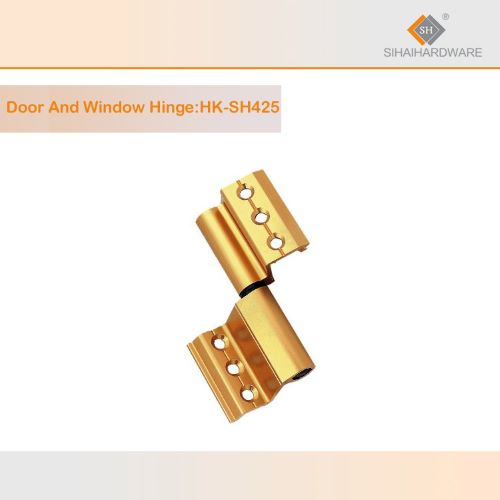
The knuckle of a heavy duty hinge —the interleaved section where the leaves join around the pin—receives special design attention. Standard hinges typically have five knuckles, with the pin passing through alternating sections of each leaf. Heavy-duty hinges often extend this to seven or more knuckles, distributing the load across a greater bearing length. Each knuckle section is also longer in the axial direction, providing more bearing surface area per section. The knuckle bore is precision-reamed rather than simply drilled, ensuring a close tolerance fit with the bearing assemblies. This precision prevents the uneven loading that occurs when a loose-fitting pin allows one knuckle to carry more load than its neighbours.
Fastener Engineering for Extreme Loads
The screws supplied with a heavy duty hinge are not afterthoughts. They are engineered components selected to match the hinge's load capacity. Standard hinges typically use screws of 8 or 10 gauge. Heavy-duty hinges specify screws of 12 or 14 gauge, with a substantial increase in minor diameter that directly increases shear strength. The screws are manufactured from hardened steel rather than the mild steel or brass common in standard hinge screws. Thread geometry is selected for the specific frame material: coarse threads for timber, finer threads with thread-forming profiles for aluminium, and machine screw threads for steel reinforcement inserts. The number of screw holes per leaf also increases—heavy-duty hinges often feature six or eight holes per leaf rather than the standard three or four, distributing the load across more fastening points and reducing the stress on each individual screw.
The Role of the Pin
The hinge pin in a heavy duty hinge is a structural element in its own right. Standard pins are simple wire forms, often as small as 5 millimetres in diameter. Heavy-duty pins range from 8 to 12 millimetres or more. The pin material is typically hardened stainless steel or carbon steel with a corrosion-resistant coating. The larger diameter serves two functions. It increases the bearing area between the pin and the knuckle, reducing contact stress. It also increases the pin's bending stiffness, preventing the deflection that would allow the door to sag. Some designs incorporate a fixed pin that is pressed or welded into one leaf, eliminating the clearance that develops in removable-pin designs over time. This fixed-pin configuration increases rigidity but requires the hinge to be installed as a complete unit rather than hung leaf by leaf.
Load Testing and Certification
A heavy duty hinge earns its rating through standardised testing that standard hinges never undergo. Testing to ANSI/BHMA standards subjects the hinge to static loads of up to 900 kilograms, applied at the door edge to create maximum bending moment. The hinge must support this load without permanent deformation exceeding specified limits. Cycle testing subjects the hinge to hundreds of thousands of opening and closing cycles under load, verifying that the bearing system maintains its performance without developing excessive play. Corrosion testing, typically salt spray exposure per ASTM B117, verifies that the materials and finishes withstand the specified environmental conditions. These certifications provide assurance that the hinge will perform as rated, not just when new but through the full expected service life.
Conclusion
A heavy duty hinge holds a 200-pound door not by being a bigger version of a standard hinge, but by being a fundamentally reengineered system. Thicker leaves resist bending. Ball or needle bearings replace simple metal-to-metal contact. Extended knuckle length and precision bores distribute bearing loads. Engineered fasteners maintain grip in the frame material. Hardened pins resist deflection. Each of these design elements addresses a specific failure mode of standard hinges under heavy loads. The result is a hinge that can carry extreme weight through millions of cycles while maintaining the precise alignment essential for door security and weather sealing.