ARTICLE NO.135 | Why Cheap Window Stays Rust First at the Rivets
ARTICLE NO.135 | Why Cheap Window Stays Rust First at the Rivets
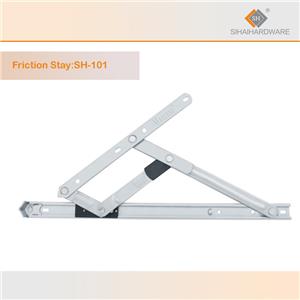
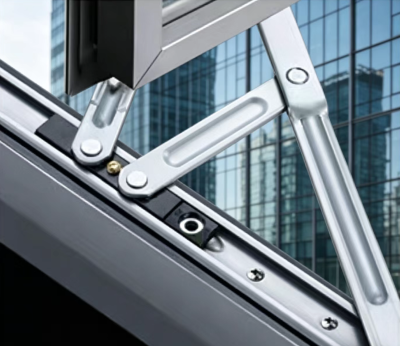
The window friction stay is expected to perform reliably for years in demanding environmental conditions. Exposed to driving rain, coastal salt spray, and condensation cycling, it must maintain both structural integrity and calibrated frictional characteristics. Yet field experience consistently reveals a predictable failure pattern in budget-grade hardware: corrosion initiates not evenly across the component, but with remarkable selectivity at the rivet connections. Rivet heads, shanks, and the immediately surrounding metal become anodic sites where rust blooms while adjacent areas remain relatively unaffected. This localisation is neither random nor unavoidable—it is the direct consequence of specific engineering decisions made to reduce manufacturing cost.
The Rivet as an Electrochemical Cell
A rivet in a window friction stay forms a permanent joint between metal layers, typically securing the connecting arm to the sliding shoe or the sash bracket to the frame. The riveting process involves inserting a ductile metal pin through aligned holes and deforming the tail to create a second head, clamping the layers under residual tensile stress. This creates precise conditions for crevice corrosion. The interface between the rivet shank and the hole wall forms an occluded region—a narrow gap of 0.05 to 0.15 millimetres—where the local chemical environment diverges dramatically from the bulk surface. Oxygen cannot diffuse effectively into this tight crevice, becoming depleted while metal dissolution continues and generates excess metal ions. Chloride ions from the external environment migrate in to maintain charge neutrality, forming metal chlorides that hydrolyse to produce hydrochloric acid. The pH within the crevice can drop to 2 or 3, creating an aggressively acidic micro-environment that accelerates metal dissolution. Meanwhile, the external surface adjacent to the crevice, still oxygen-exposed, functions as the cathode. This establishes a self-sustaining corrosion cell where the crevice interior dissolves anodically while the exterior remains cathodically protected.
Galvanic Coupling: The Hidden Battery
Budget window friction stay designs frequently compound the crevice corrosion problem through inadvertent galvanic coupling. In quality stainless steel stays, all components are manufactured from the same grade—typically 304 or 316 austenitic stainless—so no significant galvanic driving force exists. Cheaper assemblies, however, substitute materials in ways that create strong galvanic couples. A common cost-reduction strategy uses stainless steel for the track and arms but forms rivets from zinc-plated carbon steel or aluminium alloy. When dissimilar metals contact in the presence of an electrolyte—the moisture film on any surface exposed to humid air—a galvanic cell is established. The more electronegative metal becomes the anode and corrodes preferentially. In the galvanic series, zinc sits at approximately -1.0 volt relative to a saturated calomel electrode, while passive 304 stainless steel sits near -0.05 to +0.10 volt. A zinc-plated steel rivet connecting two stainless steel arms becomes a sacrificial anode with extremely high galvanic current density due to the unfavourable cathode-to-anode area ratio—a small anode coupled to a large cathode represents the worst-case configuration for galvanic corrosion.
Stress Corrosion Cracking at the Rivet Tail
The riveting process in a window friction stay introduces residual tensile stresses that enable a third degradation mechanism: stress corrosion cracking. During installation, the rivet tail is plastically deformed, leaving the shank under substantial residual tensile stress at the transition radius where the shank meets the formed head. In austenitic stainless steels, stress corrosion cracking requires tensile stress above a threshold, a chloride-rich corrosive environment, and a susceptible microstructure. The crevice at the rivet-hole interface provides the chloride medium. Residual tensile stress from riveting provides the mechanical driving force. And microstructural features—sensitised grain boundaries from improper heat treatment or strain-induced martensite in cold-worked 300-series stainless—provide the metallurgical susceptibility. Cracks propagate along grain boundaries or transgranular cleavage planes, initiating at the crevice root where stress and chloride concentrations both peak. Because these cracks are hidden within the joint, they can propagate to a significant fraction of the rivet cross-section before detection. A rivet appearing intact externally may have lost 50 percent or more of its load-bearing area, creating a latent failure awaiting a wind gust to trigger complete fracture.
Surface Finish and Passivation Deficiencies
The surface condition of rivets in a window friction stay decisively influences corrosion initiation. Quality stainless steel rivets undergo passivation—a chemical treatment using nitric or citric acid that removes free iron and promotes formation of a uniform chromium oxide passive layer. This layer gives stainless steel its corrosion resistance, reducing the corrosion rate by three to five orders of magnitude. Passivation also removes microscopic iron particles embedded during machining that would otherwise act as local galvanic anodes. Budget manufacturers often eliminate passivation to reduce processing time and chemical costs. Unpassivated rivets carry surface contamination and a disrupted oxide layer providing numerous initiation sites for localised corrosion. The situation worsens when mechanical finishing processes—tumbling, barrel polishing, or abrasive cleaning—substitute for chemical passivation. These processes embed abrasive particles, work-harden the surface, and create a disrupted, stressed layer that is electrochemically more active than the underlying metal.
Design Solutions and Material Selection
Preventing premature rivet corrosion in a window friction stay requires appropriate material selection and corrosion-conscious design. For coastal environments, all components including rivets should be manufactured from 316 austenitic stainless steel with molybdenum content of 2.0 to 2.5 percent, providing a minimum PREN of 25. All stainless components must be passivated after machining operations are complete. The rivet joint design should incorporate moisture-excluding features: sealed rivets with captive sealing washers, moisture-displacing corrosion inhibitors applied during assembly, or anaerobic thread-locking compounds that cure in the crevice and prevent moisture ingress. The cathode-to-anode area ratio must be managed by ensuring all components are electrochemically compatible. Regular maintenance—cleaning with fresh water to remove chloride deposits and applying light protective lubricant to exposed rivet heads—can substantially extend service life.
Conclusion
The corrosion of rivets in a cheap window friction stay is an electrochemically deterministic outcome of specific cost-cutting decisions. The rivet connection inherently creates crevice geometry concentrating chloride attack. Material substitution establishes galvanic couples driving preferential rivet dissolution. Elimination of passivation leaves surface contamination that nucleates localised corrosion. Residual stresses from riveting create conditions for hidden stress corrosion cracking. For the specifier, a stay failing at its rivets within three to five years in a coastal installation incurs replacement costs—scaffolding, labour, and disruption—dwarfing any initial procurement saving. The rivet, so small on a product drawing, proves to be the component where corrosion engineering meets the harsh reality of the installed environment.