ARTICLE NO.124 | Exploring the Mechanical Principles of Window Stays
ARTICLE NO.124 | Exploring the Mechanical Principles of Window Stays
When examining the hardware of a casement or awning window, most attention is directed toward the hinges that facilitate movement. Yet the component that governs control, stability, and safety is the window stay. Understanding the mechanical principles behind a window stay is essential for specifiers, installers, and maintenance personnel alike. Far from being a simple prop, the window stay is a precision mechanism that relies on controlled friction, leverage ratios, and material elasticity to perform its function reliably over thousands of cycles.
Fundamental Mechanical Structure of a Window Stay
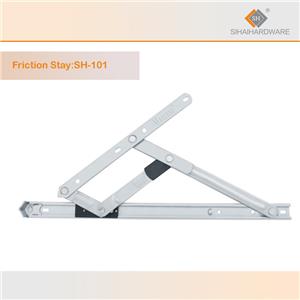
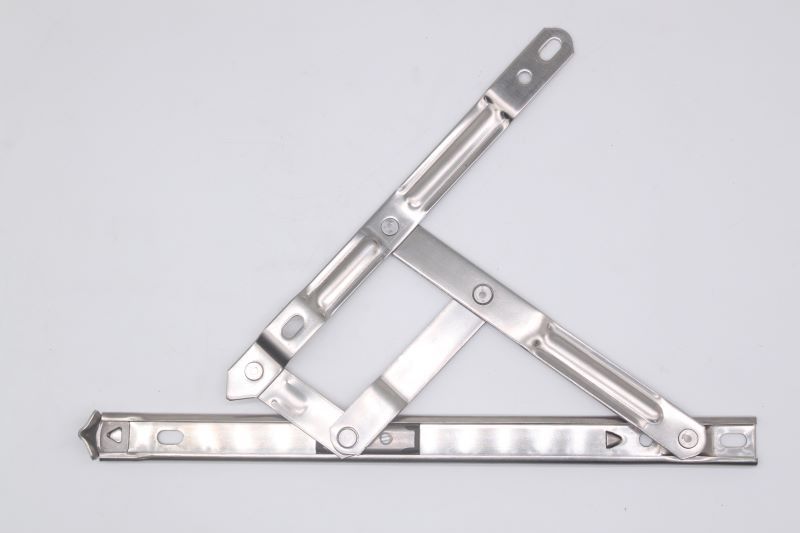
A typical window stay consists of four primary structural elements working in concert. The first is the track, a slotted channel mounted to the fixed window frame. The second is the sliding shoe, a block that travels within the track and contains the friction-generating mechanism. The third is the connecting arm, a rigid link that joins the sliding shoe to the fourth element: the sash bracket, which is fixed to the movable window sash. Together, these components form a slider-crank mechanism, a classic four-bar linkage variant wherein the track serves as the fixed link, the sliding shoe as the slider, and the arm and sash as the connecting and output links respectively.
The Physics of Friction Engagement
The core mechanical principle governing a window stay is controlled sliding friction. Within the sliding shoe resides a friction pad or spring-loaded wedge assembly. When the window is stationary, this pad is pressed against the inner walls of the track with a specific normal force. The product of this normal force and the coefficient of friction between the pad and track material determines the static holding force of the window stay. This force must be precisely calibrated. If the friction is too low, the window stay cannot resist wind loads, resulting in unintended sash closure or slamming. If the friction is too high, the operating force required from the user exceeds ergonomic limits, making the window difficult to open or close.
The friction pad material is carefully selected based on tribological principles. Common materials include sintered bronze impregnated with lubricant, high-density polyethylene, or proprietary polymer blends. These materials are chosen for their stable coefficient of friction across a wide temperature range and their resistance to stick-slip phenomena—the jerky motion that occurs when static friction significantly exceeds kinetic friction. A well-designed window stay exhibits smooth, consistent resistance throughout its entire travel stroke.
Kinematic Analysis of the Slider-Crank Mechanism
The geometry of a window stay directly influences the mechanical advantage and the sash opening angle. As the sash is pushed outward, the connecting arm pulls the sliding shoe along the track. The relationship between sash angular displacement and shoe linear displacement is non-linear, governed by trigonometric functions derived from the arm length and pivot positions. At small opening angles, a small movement of the shoe corresponds to a relatively large angular change of the sash. Near the fully extended position, however, the mechanical advantage shifts dramatically. The window stay arm approaches an over-center or toggle position, where the line of force passes very close to the pivot point. In this region, the mechanism provides maximum resistance to closing forces, effectively locking the sash open against wind gusts.
Load Distribution and Stress Analysis
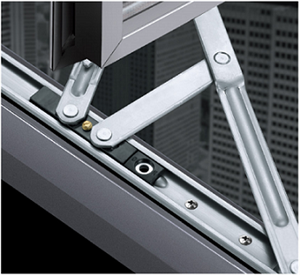
From a structural mechanics perspective, the window stay functions as a secondary load path. When the sash is open and subjected to wind pressure, the primary hinges experience bending moments. The window stay counteracts these moments by introducing a reactive force at the sash bracket. This force is transmitted through the connecting arm, resolved into longitudinal and transverse components at the sliding shoe, and ultimately transferred to the frame via the track fasteners. The arm of the window stay is therefore subject to combined bending and axial compressive loading. Engineers account for this by specifying high-tensile stainless steel or zinc alloy with reinforced ribbed cross-sections to prevent buckling under peak wind loads.
Material Selection and Tribological Considerations
The longevity of a window stay is heavily dependent on wear mechanisms at the sliding interfaces. Abrasive wear occurs when hard particles, such as airborne dust or construction debris, become embedded in the friction pad and score the track surface. Adhesive wear can occur if the lubrication film breaks down, causing micro-welding between the pad and track asperities. Premium window stay designs mitigate these effects through several strategies. The track is often manufactured from stainless steel with a polished or passivated surface finish to minimize roughness. The sliding shoe incorporates a wiper seal to exclude contaminants from the track interior. Additionally, the friction pad may be designed with grooves or reservoirs to retain lubricant and channel wear debris away from the contact zone.
Restricted Opening Mechanisms
Safety regulations frequently require a window stay to incorporate a restricted opening function. Mechanically, this is achieved by introducing a discrete stop within the track or by using a secondary latch on the connecting arm. When the window stay reaches the restricted position, typically corresponding to a 100mm gap at the sash opening edge, a spring-loaded plunger engages a notch in the track, providing a positive mechanical stop. To override this restriction for cleaning or emergency egress, the user must deliberately depress a release button. This action retracts the plunger against spring force, allowing the sliding shoe to continue its travel to the fully open position. This dual-mode operation represents a clever integration of detent mechanisms and friction control within a single compact assembly.
Conclusion
The window stay embodies a remarkable convergence of classical mechanics, materials science, and precision manufacturing. Its slider-crank kinematics provide the geometric advantage necessary for controlled ventilation, while its carefully calibrated friction interface ensures stable positioning under variable environmental loads. Understanding these mechanical principles—from the coefficient of friction at the pad-track interface to the buckling resistance of the connecting arm—enables informed selection and specification. A properly engineered window stay is not merely an accessory; it is a critical safety and performance component whose mechanical integrity directly impacts the longevity and usability of the entire window assembly.