ARTICLE NO.159 | Work Hardening of Stainless Steel Stays: How Cold Forming Affects Long-Term Durability
ARTICLE NO.159 | Work Hardening of Stainless Steel Stays: How Cold Forming Affects Long-Term Durability
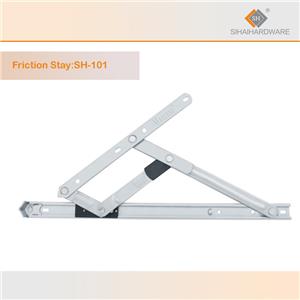
The stainless steel in a window friction stay is not the same material that left the steel mill. By the time it reaches the finished product, it has been bent, stamped, punched, and drawn through a series of cold forming operations that fundamentally alter its mechanical properties. This transformation—work hardening—gives the stay its strength and spring characteristics. But it also introduces residual stresses, microstructural changes, and vulnerabilities that influence how the stay performs over years of cyclic loading. Understanding work hardening reveals why manufacturing quality matters as much as material grade in determining friction stay durability.
What Cold Forming Does to Stainless Steel
When austenitic stainless steel is shaped at room temperature, the metal's crystal structure changes irreversibly. The window friction stay components start as flat strip or sheet stock in the annealed condition—soft, ductile, and easily formed. As the material is bent into the track profile, stamped to create the arm geometry, and punched to form rivet holes, the metal yields and flows plastically. Each forming operation multiplies dislocations within the atomic lattice—line defects that allow layers of atoms to slide past each other. These dislocations multiply rapidly and become entangled, making further deformation progressively more difficult. The yield strength of a typical 304 stainless steel component can increase from around 250 MPa in the annealed condition to over 500 MPa after heavy cold working. This doubling of strength is essential to the stay's function: the thin arms and track must resist bending under wind loads without permanent deformation, and the spring elements must return reliably to their original position after each cycle.
How Work Hardening Varies Across the Part
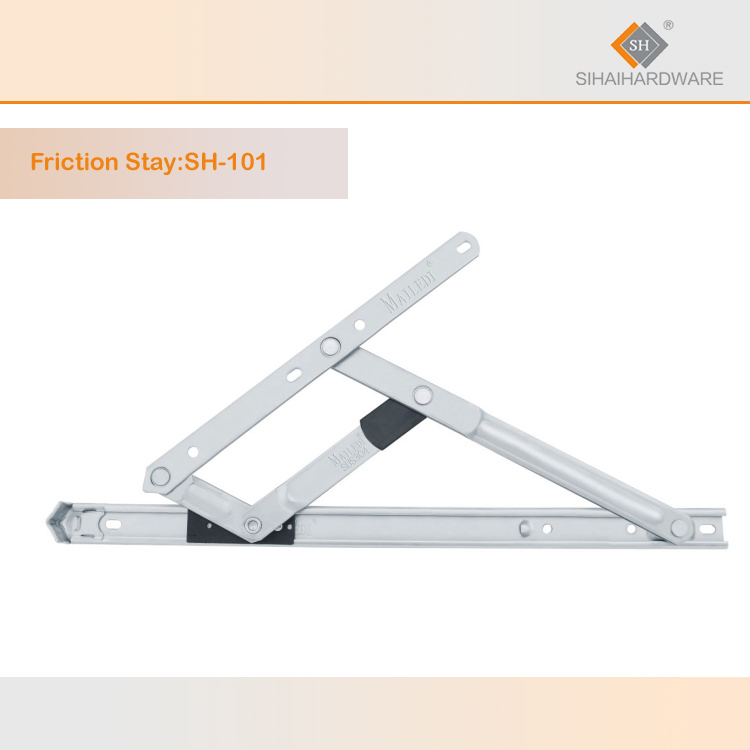
Work hardening in a window friction stay is not uniform. The rivet holes experience the most intense cold work. Punching a hole through stainless steel concentrates plastic strain at the hole perimeter, creating a zone of highly hardened material extending approximately half the material thickness outward from the hole edge. This locally hardened zone is beneficial in one respect—it increases the bearing strength where the rivet shank presses against the hole wall, resisting the elongation that leads to joint looseness. But it also creates a steep hardness gradient between the hole edge and the surrounding material. Under cyclic loading, this gradient can become a site for fatigue crack initiation. The bend radii on formed arms also concentrate cold work. The outer fibres of a bend stretch and harden more than the inner fibres, creating asymmetric properties through the material thickness. This asymmetry can cause the arm to spring back inconsistently after repeated loading, contributing to the gradual loss of calibrated holding force.
Residual Stress: The Hidden Legacy of Forming
Every cold forming operation leaves behind residual stresses in a window friction stay. When metal is bent, the outer surface fibres are stretched beyond their elastic limit while the inner fibres are compressed. After the forming load is removed, the elastic portion of the deformation attempts to recover, but the plastic portion prevents full recovery. The result is a locked-in stress pattern: compressive residual stress on the inner surface of a bend, tensile residual stress on the outer surface. These residual stresses can be beneficial or harmful depending on how they interact with service loads. Compressive residual stress at the surface improves fatigue resistance because fatigue cracks cannot propagate through compressed material. Tensile residual stress at the surface does the opposite—it adds to the applied tensile stress from service loads, making fatigue crack initiation more likely. The net effect depends on the specific forming sequence and whether the manufacturer employs stress-relief operations after forming.
The Partial Annealing Trade-Off
Some manufacturers of premium window friction stay products employ a partial stress-relief heat treatment after cold forming. This treatment, typically performed at 250 to 350 degrees Celsius for several hours, allows dislocations to reorganise into lower-energy configurations without fully recrystallising the microstructure. The yield strength drops slightly—perhaps 5 to 10 percent—but the residual stresses are significantly reduced, and the material's ductility and fatigue resistance improve. This trade-off represents an engineering decision: accept a modest reduction in strength in exchange for substantially better long-term fatigue performance. Budget manufacturers often skip this step entirely, shipping stays with the full cold-worked strength but also with high residual stresses that may contribute to premature cracking at stress concentration points.
Spring Properties and Cold Work
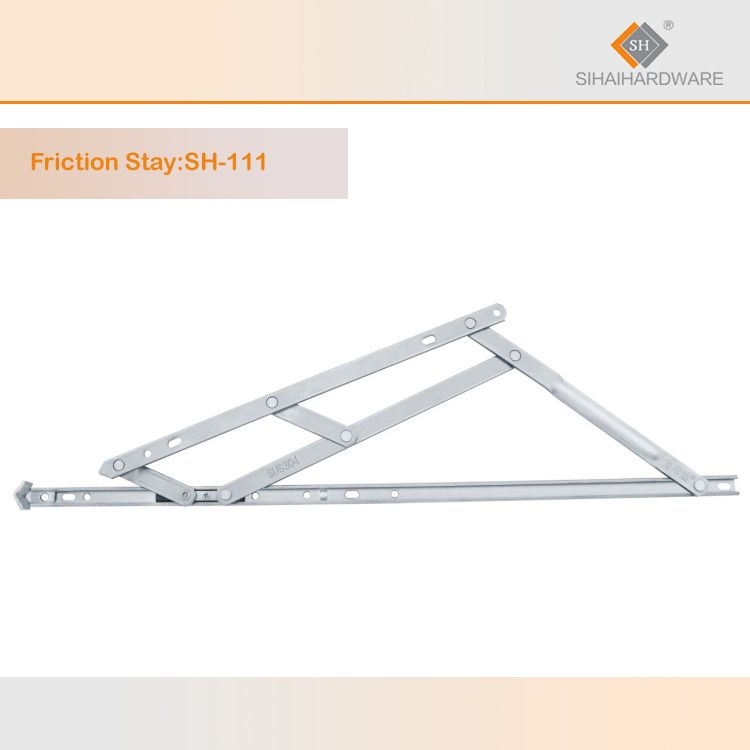
The spring action of a window friction stay —the force that presses the friction pad against the track—depends directly on cold work. The spring element, whether a separate coil spring or an integrally formed leaf spring within the sliding shoe, requires a high elastic limit to function. The material must be able to deflect repeatedly and return to its original position without permanent set. Cold working raises the elastic limit by increasing the dislocation density, making it harder for permanent slip to initiate. However, the same cold work that raises the elastic limit also reduces the material's ability to accommodate further plastic strain without cracking. A heavily cold-worked spring can maintain its force for thousands of cycles, but if it is ever overloaded beyond its raised yield point, it is more likely to fracture than a softer, more ductile spring would be. This is why friction stays that have been forced—by wind slamming the sash open, or by a user forcing a stiff mechanism—often fail at the spring rather than at the visibly larger structural components.
Identifying Quality Through Cold Work Patterns
The surface finish of a window friction stay provides visual clues about the quality of its cold forming process. Smooth, consistent bend radii without surface orange peel or micro-cracking indicate that the forming was performed at an appropriate rate and with properly maintained tooling. Sharp burrs around punched holes suggest worn or damaged punch tooling, which creates stress concentrations and micro-cracks at the hole perimeter. Uniform material thickness through bends, without visible necking or thinning, indicates that the bend radii were designed to match the material's formability limits. These visual indicators are not merely cosmetic. They reflect the underlying cold work distribution that determines how the stay will respond to years of cyclic loading.
Conclusion
The window friction stay that operates smoothly for a decade owes its durability as much to its manufacturing process as to its material specification. Cold forming transforms soft, ductile stainless steel into a strong, spring-like mechanism capable of resisting wind loads and returning reliably through thousands of cycles. But that same transformation creates residual stresses and hardness gradients that can become failure initiation sites if the forming process is not properly controlled and followed by appropriate thermal treatment. The difference between a stay that maintains its performance and one that develops play or cracks within a few years often traces back to decisions made at the forming press—decisions about tooling condition, forming sequence, and whether to invest in post-form stress relief. In friction stay engineering, the cold work that gives the material its strength also plants the seeds of its eventual fatigue, and managing that duality is the essence of durable design.