ARTICLE NO.157 | How Does a Small Wheel Carry a Heavy Glass Door? The Rolling Principle
ARTICLE NO.157 | How Does a Small Wheel Carry a Heavy Glass Door? The Rolling Principle
A glass door weighing 100 kilograms glides silently along an aluminium track, supported by four small wheels no larger than a coin. The contrast between the substantial mass of the door and the diminutive size of the roller wheels seems to defy common sense. A heavy object placed on a small point of contact should sink, crush, or seize. Yet millions of sliding doors operate smoothly for decades on rollers that fit in the palm of a hand. The explanation lies not in the strength of the roller alone, but in the fundamental physics of rolling contact—a principle that distributes immense loads across tiny areas while converting sliding friction into dramatically lower rolling resistance.
The Difference Between Sliding and Rolling
To understand how a small roller carries a heavy door, it helps to first consider what it is not doing. The roller is not sliding along the track. If the same 100-kilogram door were dragged along its track without wheels, the sliding friction would be enormous. The force required to move it would be roughly 30 to 40 percent of the door's weight—around 30 to 40 kilograms of push force. The aluminium track would score and gouge within weeks. The door would be practically inoperable. A rolling wheel changes this entirely. When a wheel rolls without slipping, the point of contact between the wheel and the track is momentarily stationary relative to the track surface. There is no sliding motion at the contact point, and therefore no sliding friction in the classical sense. What remains is rolling resistance, which for a hard wheel on a hard surface is typically only 1 to 3 percent of the sliding friction that would exist without the wheel. This is why a child can push a heavy sliding door once it is properly mounted on functioning rollers—the child is overcoming a tiny fraction of the force that would be needed to drag the same door across the same surface.
Contact Pressure: Small Area, Big Numbers
The roller wheel contacts the track over a very small area—a contact patch that may be only a few square millimetres. Simple division suggests enormous pressure. A 25-kilogram load per wheel, divided by a contact area of perhaps 5 square millimetres, yields a contact pressure of approximately 50 megapascals. This is a substantial stress, but it is well within the bearing capacity of hardened steel or engineering polymers. The materials used in quality rollers are specifically selected to handle these pressures without permanent deformation. Hardened steel rollers, typically through-hardened to 58 to 62 on the Rockwell C scale, can sustain contact pressures exceeding 1000 megapascals before yielding. The aluminium track, with its lower hardness, is protected by the geometry of the contact: a curved roller on a flat or slightly grooved track creates a contact ellipse, not a sharp point, and the load spreads over a calculable area determined by the roller radius and the elastic properties of both materials.
The Role of the Bearing
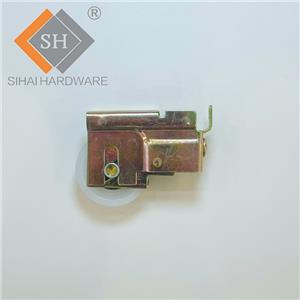
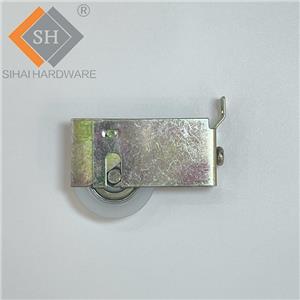
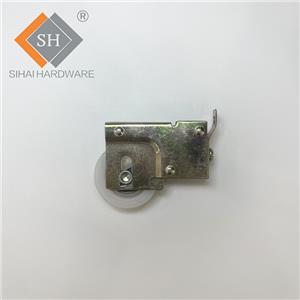
Inside every roller wheel is a bearing that is at least as important as the wheel itself. The wheel rolls on the track, but it must also rotate freely around its axle. Without a bearing, the friction between the wheel bore and the axle would consume much of the benefit of rolling. Quality sliding door rollers use deep-groove ball bearings, which reduce the friction at the axle to a tiny fraction of the load. A ball bearing operates on the same principle as the wheel itself—balls roll between inner and outer races, replacing sliding friction with rolling resistance at the axle interface. The bearing also serves a structural function. It maintains the precise alignment of the wheel on its axle, ensuring that the wheel rolls in a consistent plane without wobbling or skewing. A wheel that wobbles concentrates its load onto a smaller portion of the contact patch, increasing local stress and accelerating wear on both the wheel and the track. A precision bearing holds the wheel true, distributing the door's weight evenly across the full contact width throughout every cycle.
Material Pairs and Load Distribution
The roller and track form a material pair whose compatibility determines the life of the entire sliding system. The classic combination in architectural hardware is a hardened steel roller running on a stainless steel or anodised aluminium track. The steel roller provides high load capacity and excellent wear resistance. The track material is selected for corrosion resistance and compatibility with the roller. In systems designed for quieter operation, polymer rollers—typically acetal, polyamide, or polyurethane—run on aluminium or stainless steel tracks. These polymer rollers are softer than the track, which is intentional. The polymer deforms slightly under load, increasing the contact patch area and reducing contact pressure. This is the same principle that allows rubber tyres to carry heavy vehicles on paved roads. A polymer roller also absorbs vibration and operates more quietly than a steel roller, an important consideration in residential applications. The trade-off is that polymer rollers wear faster than steel and require periodic replacement. However, replacing a set of polymer rollers every five to eight years is far less expensive than replacing a scored aluminium track.
Why Four Wheels, Not One
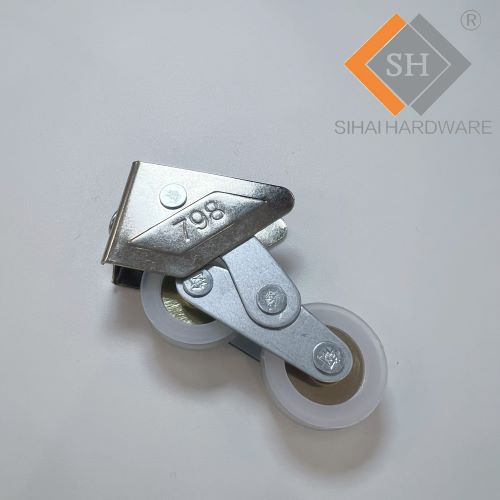
A sliding glass door typically runs on four roller wheels—two on each of two tandem assemblies. This four-point support is not redundant. If a single roller carried the full door weight, the contact pressure would quadruple, likely exceeding the capacity of the track material. The four-wheel arrangement also provides stability. A door supported by a single roller at each end would be prone to rocking if the track had any unevenness. The tandem arrangement—two wheels in line on each assembly—creates a stable platform that bridges small track irregularities. Each wheel can rise or fall slightly while the assembly maintains overall contact through at least one wheel at each end. This is why a sliding door can continue to operate smoothly even when the track has minor imperfections or has accumulated small amounts of debris. The redundancy of the four-wheel system is also a safety feature. If one wheel seizes or fails, the remaining three can continue to support the door temporarily, preventing a sudden collapse that could shatter the glass panel.
The Limits of the Rolling Principle
The rolling principle that allows a small roller to carry a heavy door has limits, and exceeding them leads to rapid failure. The most common limit encountered in practice is track deformation. If the roller load exceeds the track material's capacity, the track surface yields, creating a depression. Once a depression forms, the roller must climb out of it with each passage, and the smooth rolling motion degrades into a series of impacts. These impact loads far exceed the static load and can rapidly destroy both roller and track. Another limit is contamination. The rolling principle assumes clean, smooth surfaces. When debris particles larger than the lubricant film thickness enter the contact zone, they disrupt the smooth rolling action. Hard particles can indent the track surface. Soft particles can accumulate and form a layer that the roller must push through, increasing resistance. This is why sliding door tracks must be kept clean and why rollers in dusty environments require more frequent maintenance.
Conclusion
The small roller wheels that carry heavy glass doors do not rely on brute strength. They work through the elegant physics of rolling contact, which replaces the high forces of sliding friction with the dramatically lower resistance of rolling. The concentrated load at the contact patch is managed by selecting materials with sufficient hardness and by using precise bearings that maintain alignment. The four-wheel configuration distributes the load and provides redundancy. The result is a system in which a door weighing as much as a person can be moved with the effort of a single finger. The roller, small as it is, represents one of the most efficient applications of classical mechanics in everyday architectural hardware.