ARTICLE NO.145 | The Four-Bar Linkage Kinematics of a Friction Stay: Instantaneous Centers and Velocity Profiles
ARTICLE NO.145 | The Four-Bar Linkage Kinematics of a Friction Stay: Instantaneous Centers and Velocity Profiles
The window friction stay appears mechanically simple—a sliding shoe, a connecting arm, and a track. Yet this compact assembly embodies one of the most elegant mechanisms in classical kinematics: the four-bar linkage. Every time a casement window opens or closes, the stay performs a precisely choreographed motion in which the instantaneous center of rotation shifts continuously along the track, the mechanical advantage varies through the stroke, and the sash accelerates and decelerates according to predictable mathematical relationships. Understanding this kinematic behaviour explains why friction stays are shaped the way they are, why the arm lengths are not arbitrary, and why the sliding shoe must maintain contact with the track in a specific orientation.
The Four-Bar Linkage Defined
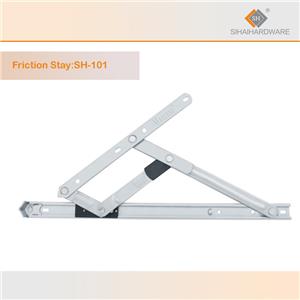
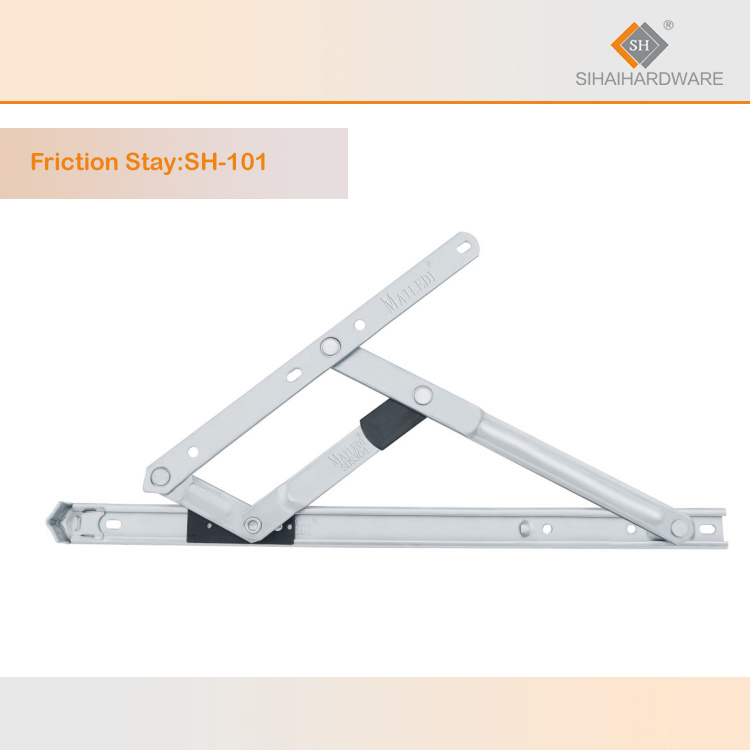
A four-bar linkage consists of four rigid bodies connected by four revolute joints forming a closed kinematic chain. In a window friction stay, the four links are easily identified. The fixed frame serves as the ground link. The sash bracket attached to the moving window sash functions as the output link, rotating about the hinge axis. The connecting arm links the sash bracket to the sliding shoe, and the sliding shoe itself translates along the track, which is rigidly mounted to the fixed frame. The track constrains the shoe to linear motion, effectively functioning as a prismatic joint combined with a revolute joint at the shoe-arm connection. This hybrid arrangement—three revolute joints and one sliding joint—classifies the mechanism as a slider-crank inversion of the four-bar linkage, where the slider does not revolve around a fixed pivot but instead moves linearly along a fixed guide.
Instantaneous Centers of Rotation
Every moving body in a plane has an instantaneous center of rotation—a point about which it appears to rotate at a given instant. The window friction stay has several such centers, and their locations determine the mechanical behaviour of the entire assembly. The sash rotates about its hinge axis, which is the fixed instantaneous center between the sash and the frame. The connecting arm has its own instantaneous center, found at the intersection of lines perpendicular to the velocity vectors of its two endpoints. One endpoint velocity is determined by the sash rotation; the other is constrained to move linearly along the track. As the window opens through its arc, the instantaneous center of the connecting arm migrates along a curve called the fixed centrode. Simultaneously, the instantaneous center of the sliding shoe relative to the track is technically at infinity in the direction perpendicular to the track, because the shoe translates without rotation. The interaction of these instantaneous centers governs how the input force applied at the sash is transmitted through the linkage to the friction shoe.
Velocity Analysis Through the Stroke
The velocity profile of a window friction stay reveals why the window feels different at various opening angles. When the sash is near the closed position, a small angular velocity of the sash produces a relatively high linear velocity of the sliding shoe along the track. The mechanical advantage in this region is low—the user must apply significant force to move the sash through the initial opening phase, but the sash moves quickly in response. As the sash approaches the fully open position, the kinematic relationship inverts. The same sash angular velocity produces a much smaller shoe linear velocity. The mechanical advantage increases substantially, meaning the sash offers greater resistance to closing forces from wind but also requires less user effort to hold in position. This velocity transformation is not linear; it follows a trigonometric relationship determined by the lengths of the connecting arm and the position of the sash pivot relative to the track. The changing velocity ratio is the kinematic reason why a friction stay provides variable holding force through the opening arc, with the greatest resistance near full extension where wind loads are typically highest.
Geometric Constraints on Design
The four-bar kinematics impose strict geometric constraints on window friction stay design. The track length must accommodate the full travel range of the sliding shoe without allowing the shoe to reach either end stop during normal operation. If the shoe bottoms out at the track end, the linkage locks and the sash cannot open further—a condition that places enormous stress on the rivet joints and can cause permanent deformation. The connecting arm length determines the maximum sash opening angle. A longer arm produces a wider opening angle for the same track length, but it also increases the bending moment on the arm under wind load. The offset distance between the sash hinge axis and the track mounting position is perhaps the most critical dimension. Too small an offset, and the linkage approaches a toggle position where mechanical advantage becomes so high that the user cannot easily close the window. Too large an offset, and the shoe travel becomes excessive relative to the sash movement, requiring an impractically long track. The standard geometry found in most residential friction stays—with an arm length of approximately 200 to 300 millimetres and a track offset of 15 to 25 millimetres—represents a compromise that balances these competing kinematic demands.
The Role of the Secondary Arm
Many window friction stay designs incorporate a secondary stabilising arm in addition to the primary connecting arm. This secondary arm does not alter the fundamental four-bar kinematics but adds an additional constraint that controls the orientation of the sash bracket throughout the stroke. Without this secondary link, the sash bracket could rotate relative to the connecting arm, potentially allowing the sash to tilt or bind. The secondary arm forms a second four-bar linkage in parallel with the first, sharing the sash bracket and the track as common links. This parallel linkage arrangement ensures that the sash bracket maintains a constant angular relationship with the track—and therefore with the window frame—throughout the entire opening arc. The kinematic result is a sash that translates and rotates as a rigid body without developing the twisting misalignment that would cause the friction shoe to bind in its track.
Implications for Wear and Failure
The kinematic profile of a window friction stay directly influences where and how the mechanism wears. The sliding shoe experiences its highest velocity during the initial opening phase, when the sash moves from closed to approximately 30 degrees. At these high shoe speeds, the friction pad generates more heat and experiences accelerated wear. This is why many worn friction stays show the greatest track polishing and pad degradation in the section corresponding to the first third of the sash travel. The connecting arm experiences its highest forces near the fully open position, where the mechanical advantage is greatest. At this end of the stroke, the arm approaches an over-center condition, and wind loads on the sash generate high compressive forces in the arm. The rivet joints at both ends of the arm bear the brunt of these forces, and it is at these joints that cyclic fatigue and eventual loosening typically first appear. Understanding the kinematic origins of these wear patterns allows maintenance personnel to inspect friction stays more effectively, focusing attention on the track section where the shoe velocity peaks and the arm joints where the force transmission is highest.
Conclusion
The window friction stay, small and unassuming as it may appear, operates on kinematic principles that mechanical engineering students spend semesters mastering. Its four-bar linkage transforms the sash rotation into controlled linear motion, with instantaneous centers that migrate through the stroke and velocity ratios that provide variable mechanical advantage exactly where it is needed. The track length, arm geometry, and pivot positions are not arbitrary design choices—they are solutions to a set of simultaneous kinematic equations that balance opening angle, operating force, wind load resistance, and compact packaging within the window frame profile. When a friction stay operates smoothly through thousands of cycles, it is the elegant kinematics of the four-bar linkage that makes this reliability possible.