ARTICLE NO.142 | Window Stay Rusted? Should You Clean It or Replace It?
ARTICLE NO.142 | Window Stay Rusted? Should You Clean It or Replace It?
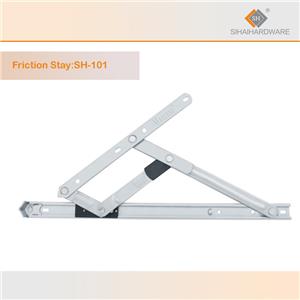
Discovering rust on a window friction stay is always a disappointing moment. The smooth stainless steel track that once allowed the window to glide open now shows brown discolouration. Orange speckles appear around the rivet heads, and the surface where the sliding shoe travels feels rough to the touch. These are clear signs that corrosion has begun, and the owner faces a practical question: can this hardware be salvaged with a thorough cleaning, or has the damage progressed far enough to require replacement? The answer depends on understanding the difference between cosmetic surface rust and structural corrosion that compromises the component's strength.
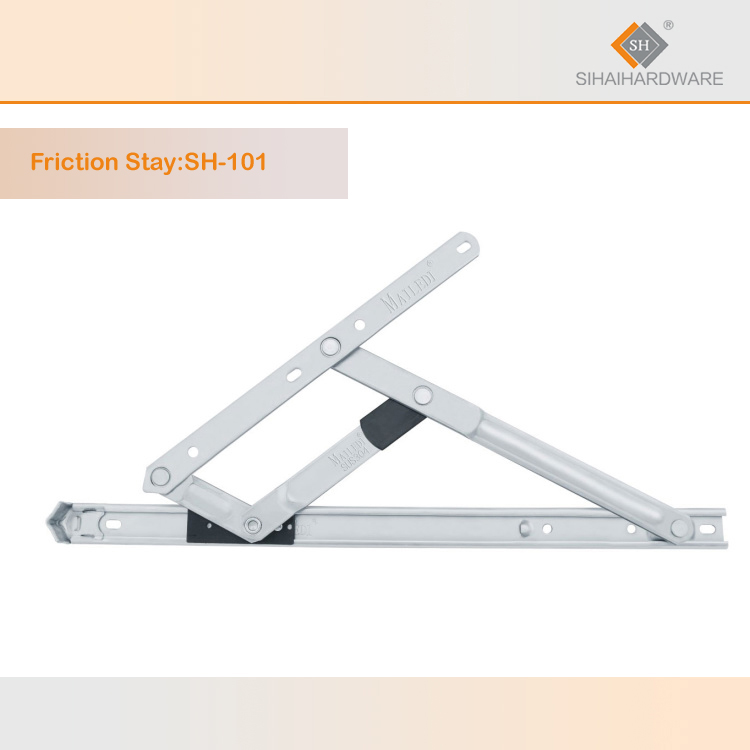
Distinguishing Surface Rust from Structural Corrosion
When examining a rusted window friction stay, the first task is determining whether the rust originates from the stainless steel itself or from external contamination. Surface contamination occurs when iron particles from other sources—construction dust, particles from nearby grinding operations, or even steel wool fibres used in previous cleaning attempts—settle on the stainless steel surface. These foreign particles rust when exposed to moisture, creating stains that sit on top of the stainless rather than within it. This type of rust can often be partially removed by wiping with a finger, and it does not indicate that the stay itself is failing. Genuine corrosion of the stainless steel looks and feels different. It presents as staining that cannot be wiped away, often accompanied by a rough texture. In more advanced cases, small pits form in the metal surface, visible as tiny dark spots or craters. Crevice corrosion at the joints between rivets and arms produces rust that appears to seep from between the layers of metal. If the surface has developed pits deeper than roughly the thickness of a sheet of paper, the structural integrity of the component is compromised.
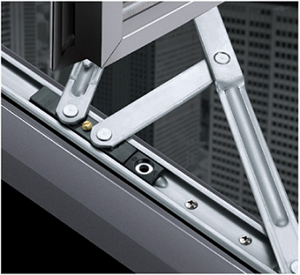
When Cleaning Is the Right Solution
If the rust on a window friction stay is confined to surface contamination, a careful cleaning procedure can restore the hardware to serviceable condition. The first step, where possible, is removing the stay from the window frame. This provides full access to all surfaces and prevents cleaning chemicals from contacting the surrounding frame or glass. If removal is impractical, masking tape and plastic sheeting should protect adjacent areas. The cleaning itself requires a dedicated stainless steel cleaner or a mild phosphoric acid-based rust remover, applied with a soft cloth or nylon bristle brush. A critical rule is never to use steel wool or ordinary wire brushes on stainless steel. These tools leave behind tiny iron particles embedded in the surface, which will themselves rust and recreate the original problem. Gentle circular motions allow the chemical cleaner to dissolve the rust, working more effectively than aggressive scrubbing. After cleaning, the stay must be rinsed thoroughly with clean water and dried immediately with a lint-free cloth to prevent water spots. The final step is applying a light corrosion-inhibiting lubricant to all moving surfaces—the track, the rivet joints, and the sliding shoe interface—and cycling the window several times to distribute the lubricant evenly.
Recognising When Replacement Is Necessary
Several specific conditions indicate that a window friction stay should be replaced regardless of how well it responds to cleaning. The first is pitting on the track surface where the sliding shoe makes contact. The friction pad inside the shoe relies on a smooth, consistent track surface to generate uniform holding force at every position along the opening arc. Pits in this critical surface disrupt the smooth passage of the shoe, causing the window to hold at some angles but drift at others. The second condition that mandates replacement is rust at rivet joints that has caused visible swelling or separation between the connected metal layers. Crevice corrosion expands as it develops, physically forcing the layers apart and loosening the rivet connection. This introduces mechanical play into the assembly, reducing the precision with which the friction pad engages the track. The third condition is any visible crack extending from a rusted area. Corrosion pits concentrate stress, and under the repeated bending that occurs with every window operation, cracks can initiate from these points. A cracked stay can fracture suddenly, releasing the sash without warning.
The Hidden Problem of Internal Corrosion
A window friction stay that appears only mildly rusted on the outside may conceal more serious damage within its mechanism. The sliding shoe houses the friction pad and a spring that presses the pad against the track. Neither of these internal components is visible without disassembling the shoe. If moisture has penetrated the housing, the spring can corrode and lose tension even while external surfaces look acceptable. A weakened spring delivers less force to the friction pad, and the stay's holding capacity diminishes without obvious external indication. Similarly, the bearing surfaces inside rivet joints can corrode while the rivet heads appear intact from the outside. Hardware that has been exposed to coastal salt spray, de-icing chemicals, or industrial pollutants is particularly susceptible to this type of hidden damage. A straightforward functional test helps evaluate internal condition: open the window to the most frequently used ventilation position, mark that position on the frame, and leave the window undisturbed for an hour. If the sash has drifted from the marked position, the holding force is insufficient regardless of how the external surfaces appear.
Making the Economic Decision
Choosing between cleaning and replacing a rusted window friction stay involves comparing costs over a realistic timeframe. Cleaning supplies—stainless steel cleaner, appropriate brushes, and protective lubricant—typically cost a fraction of a replacement unit. If the stay responds well to cleaning and passes the functional drift test, this is clearly the economical choice. However, if a cleaned stay fails within a year, the total cost includes not only the eventual replacement hardware but also the repeated labour and the potential consequences of operating a window with unreliable hardware in the interim. For any stay showing pitting on the track, swelling at riveted connections, visible cracks, or functional holding failure, replacement is the more cost-effective option when calculated over several years. If the original stay failed due to corrosion, the replacement should be an upgraded specification. Installing an identical 304 stainless steel unit in a coastal location simply restarts the same corrosion timeline. Upgrading to 316 stainless steel, which contains molybdenum for improved pitting resistance, or selecting a model with sealed rivets, addresses the root cause and prevents early recurrence.
Preventing Future Rust Problems
Whether a window friction stay has been cleaned and kept in service or replaced with a new unit, a few maintenance habits will significantly reduce the likelihood of future rust. Keeping the track and exposed metal surfaces clean and dry is the simplest and most effective measure. In coastal areas, periodically rinsing hardware with fresh water removes accumulated salt deposits that would otherwise initiate corrosion. Applying a light protective lubricant to the track and around rivet heads every six months creates a moisture-repellent film that prevents the thin electrolyte layer necessary for corrosion from establishing itself on the metal surface. When cleaning windows, avoid spraying cleaning solutions directly onto the hardware. Many commercial window cleaners contain chlorides or other compounds that can attack stainless steel, particularly in the crevice conditions found at rivet joints. For installations in particularly aggressive environments—seafront properties, buildings facing prevailing ocean winds, or industrial areas—upgrading to 316-grade stainless steel with additional protective features is a worthwhile preventative investment even before the current hardware shows signs of failure.
Conclusion
A rusted window friction stay demands a clear-eyed assessment rather than a rushed decision. Cosmetic surface rust from external contamination is not a structural threat and can be remedied with proper cleaning techniques and materials. Rust that has penetrated the metal surface, compromised riveted connections, or caused a measurable decline in the window's holding ability is a structural problem that cleaning cannot solve. The diagnostic signs are visible and specific: pits deep enough to feel, metal layers separating at rivet joints, cracks of any size, and a sash that drifts from its set position. A stay that passes inspection on all these points after cleaning can safely remain in service with regular maintenance. A stay that fails on any single point should be replaced promptly with hardware appropriate for the exposure conditions. The cost of a replacement stay is modest when measured against the potential consequences of a window that suddenly loses its restraint—consequences that can include broken glass, damaged frames, and personal injury.