ARTICLE NO.141 | Cyclic Softening of Stainless Steel Stays: How 10,000 Open-Close Cycles Change Holding Force
ARTICLE NO.141 | Cyclic Softening of Stainless Steel Stays: How 10,000 Open-Close Cycles Change Holding Force
A brand-new window friction stay feels firm and precise. The sash holds at any angle and resists wind without drifting. After several years of daily use, that same stay often feels noticeably looser—the window creeps shut or fails to stay open at the favourite ventilation position. Many assume this is simply friction pad wear, but a more fundamental process is at work: cyclic softening of the stainless steel itself. Repeated bending during every opening and closing physically changes the metal at a microscopic level, and this metallurgical transformation gradually robs the stay of its holding power.
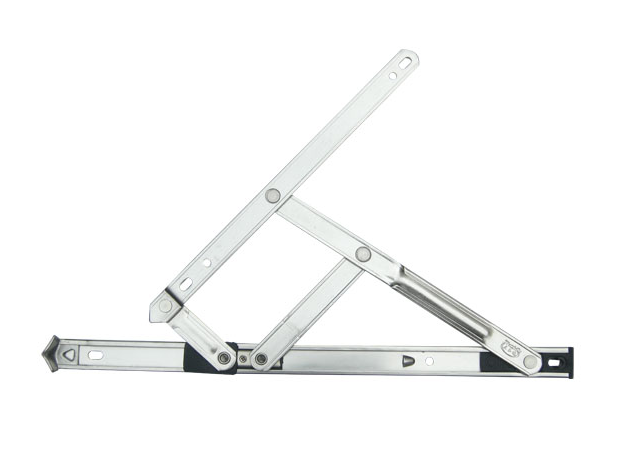
What Cyclic Softening Means
Cyclic softening occurs when metals are repeatedly loaded and unloaded. In a window friction stay, the connecting arm and sliding shoe bend slightly with each operation. Inside the metal, microscopic line defects called dislocations move and multiply. In the first few hundred cycles, these dislocations tangle together and actually make the metal slightly stronger—a brief hardening phase. But as cycling continues into the thousands, the tangled dislocations rearrange into lower-energy patterns and gradually cancel each other out. The net result is measurable: the metal literally becomes softer and more flexible than when it was new, losing 15 to 25 percent of its original yield strength.
How Softening Reduces Holding Force
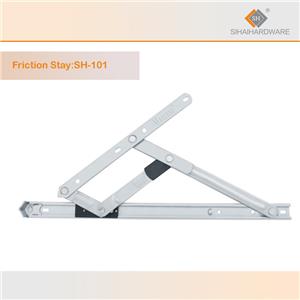
The holding force of a window friction stay depends on the friction pad pressing against the track with a specific normal force generated by the spring mechanism. When the surrounding metal components soften, two problems emerge. First, the arms flex more under the same load, allowing the sliding shoe to tilt slightly within its track. A tilted shoe concentrates clamping force onto a smaller area of the friction pad, reducing effective contact and overall friction. Second, the built-in preload established during manufacturing relaxes as softened rivet joints yield microscopically. The entire assembly becomes fractionally looser, and the friction pad no longer presses against the track with its designed force. The holding torque typically drops 20 to 30 percent after several thousand cycles.
Why Stainless Steel Is Vulnerable
Austenitic stainless steels like 304 and 316, the grades most common in quality window friction stay manufacturing, are particularly susceptible to cyclic softening. These steels gain much of their strength from cold working during the stamping and forming processes that shape the components. This cold-worked condition is metallurgically unstable. Under repeated loading, the stored strain energy dissipates as dislocations reorganise—a behaviour fundamentally different from carbon steels that stabilise more quickly. The nickel and chromium that give stainless steel its corrosion resistance also stabilise the crystal structure most prone to this softening effect.
The Rivet Problem
The riveted joints in a window friction stay are where softening causes the most damage. The metal immediately surrounding each rivet hole experiences the highest stress concentrations in the entire assembly during operation. As this metal softens, the hole elongates microscopically—a 4.00-millimetre hole may grow to 4.05 millimetres after thousands of cycles. This tiny clearance allows the rivet to shift within the hole when load direction reverses, creating backlash in the mechanism that directly reduces the precision of the friction pad engagement.
What Accelerates Softening
Several factors speed up the softening of a window friction stay beyond laboratory predictions. Heat from direct summer sun on dark-finished hardware raises surface temperatures enough to increase dislocation mobility. Corrosion pitting, even microscopic, creates stress concentrators that amplify local strain and create zones of accelerated softening that can develop into fatigue cracks. This is why coastal friction stays often lose holding force years earlier than inland installations. Overloading—a user forcing a stiff window—subjects the stay to bending stresses above its design range, creating dislocation structures particularly prone to subsequent softening.
Designing Against Softening
Premium window friction stay manufacturers combat softening through several approaches. Duplex stainless steels with mixed microstructures resist cyclic softening far better than conventional grades while maintaining corrosion resistance. Increasing material thickness in critical areas—near rivet holes, where the shoe bears against the track—reduces the strain amplitude of each cycle. Shot peening introduces compressive residual stress on component surfaces, counteracting the tensile stresses that drive softening. Limiting the maximum bending angle during normal operation keeps cyclic strain within ranges where softening progresses slowly.
Conclusion
The window friction stay that felt perfect on installation day will not feel the same after 10,000 cycles. Cyclic softening is not a defect but the expected physical behaviour of stainless steel under repeated loading. A stay selected based on its new specifications will lose a significant fraction of its holding capacity over its service life. The practical lesson is simple: the initial specification must include a performance margin to accommodate this inevitable softening. A friction stay rated just adequate when new will become inadequate long before the window reaches the end of its design life.