ARTICLE NO.126 | Understanding the Roles of Window Stays and Telescopic Stays
ARTICLE NO.126 | Understanding the Roles of Window Stays and Telescopic Stays
When it comes to keeping casement windows securely open at the desired angle, choosing the right supporting hardware is just as important as selecting the primary hinges. Two components often discussed in this context are the window stay and the telescopic stay. While they may appear similar and share the common goal of holding a sash in position, their mechanical structures and ideal applications differ significantly. Understanding these differences is key to specifying hardware that ensures both safety and long-term performance.
The Standard Window Stay: Friction-Based Control
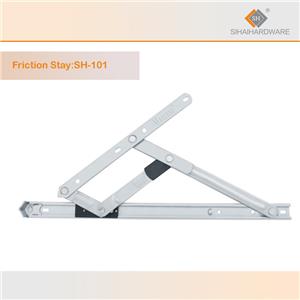
A standard window stay operates primarily on the principle of controlled sliding friction. It consists of a track mounted to the frame, a sliding shoe containing a friction pad, and a rigid connecting arm attached to the sash. The mechanism generates holding force through the friction generated between the shoe and the track. As the user opens the window, the shoe slides along the track and the friction pad resists movement, allowing the sash to hold its position at any point within its travel range. This continuous adjustability makes the standard window stay ideal for everyday ventilation control, where the user may wish to select a precise opening gap.
window stay
The Telescopic Stay: Positive Locking and Extended Reach
In contrast, a telescopic stay employs a fundamentally different mechanical approach. Rather than relying on friction alone, a telescopic mechanism consists of two or more nested arm segments that extend outward, much like the sections of a telescope. These segments are typically locked into place using spring-loaded detent pins, screw clamps, or ratchet mechanisms that engage at predetermined positions. This positive locking action provides a far stronger and more secure hold than friction alone can offer. Furthermore, the telescoping design allows a telescopic stay to achieve a significantly longer extension relative to its closed length, making it the preferred choice for applications requiring a wider opening angle or deeper sash reach.
Comparing Load-Handling Capabilities
The load-bearing characteristics of a window stay and a telescopic stay differ substantially, which dictates their respective application envelopes. A standard friction-based window stay is generally suited to lightweight residential sashes where wind loads are moderate. Because its holding force is generated entirely by friction, it has a defined maximum holding torque. If a wind gust exerts a force that exceeds this friction limit, the sash may move or slam shut. A telescopic stay, by contrast, creates a rigid, locked column between the frame and the sash. The load is transferred through the nested arm segments in pure compression or tension, depending on wind direction. This makes the telescopic stay the superior choice for heavy commercial windows, triple-glazed sashes, or installations in high-wind exposure zones where friction-based stays would be inadequate.
Applications and Selection Criteria
The choice between a window stay and a telescopic stay should be guided by several key factors: sash weight, required opening angle, wind exposure, and safety requirements. For a standard residential bedroom window where gentle ventilation is the primary goal, a restricted window stay with a friction mechanism offers quiet, smooth operation and child safety compliance. For a commercial awning window that must open to 45 degrees or more and remain rigidly fixed for smoke ventilation, a heavy-duty telescopic stay with positive locking detents is the correct specification. In some architectural designs, a telescopic stay may also be used alongside a standard window stay — the former providing the primary load support at the fully open position, while the latter offers intermediate positioning for daily use.
Conclusion
Both the window stay and the telescopic stay play vital roles in modern fenestration hardware, yet they are not interchangeable. The window stay offers continuous adjustability and quiet friction-based operation, making it the everyday workhorse for residential ventilation. The telescopic stay delivers positive mechanical locking and superior load capacity, making it the heavy-duty solution for demanding commercial and high-wind applications. By understanding the mechanical distinction between friction-based holding and positive locking, architects and installers can select the correct stay type with confidence, ensuring that every window performs safely and reliably throughout its service life.