ARTICLE NO.178 | How to Choose a Roller That Can Handle Daily Use
ARTICLE NO.178 | How to Choose a Roller That Can Handle Daily Use
A sliding door in a busy entrance may open and close fifty times a day. Over a year, that is more than 18,000 cycles. Over a decade, it approaches 200,000. The roller assemblies that carry the door through every one of those cycles must be selected not just for the weight of the door, but for the relentless accumulation of use that will be demanded of them. A roller that performs perfectly on a lightly used patio door may wear out within two years on a busy shop entrance. Choosing a roller for daily use requires understanding which specifications translate to durability, and which are irrelevant to long-term performance.
Bearing Type: The Heart of the Roller
The bearing inside a roller determines how many cycles the assembly can endure before friction increases and smooth operation degrades. The most basic rollers use a plain bearing—a simple metal sleeve or polymer bushing in which the axle rotates. Plain bearings are inexpensive and adequate for low-cycle applications, but they wear progressively with every rotation. Under daily use, a plain bearing roller will develop increasing friction within months. Ball bearings represent a significant step up in durability. Deep-groove ball bearings, sealed against contamination, can deliver 50,000 to 100,000 cycles with minimal degradation. The balls roll between hardened steel races, replacing sliding friction with rolling resistance at the axle, just as the wheel itself does at the track. For the highest daily use—commercial entrances, hospital doors, airport restroom partitions—needle roller bearings offer even greater load capacity. The cylindrical rollers provide a line of contact rather than the point contact of ball bearings, distributing the load more evenly and extending service life. When selecting a roller for daily use, the bearing type is the single most predictive specification for long-term durability.
Wheel Material and Track Compatibility
The material of the roller wheel must be matched to the track material and to the expected cycle count. Hardened steel wheels offer the highest durability and are the standard choice for heavy commercial doors. They maintain their round profile through millions of cycles and resist the flat-spotting that afflicts softer materials. Their drawback is noise—steel on steel or steel on aluminium transmits vibration efficiently, and a steel-wheeled door announces its movement to everyone nearby. For residential and office applications where quiet operation matters, polymer wheels—typically acetal, polyamide, or polyurethane—provide a better balance of durability and acoustic performance. These materials are softer than the track, which is intentional. The polymer deforms slightly under load, absorbing vibration and operating almost silently. The trade-off is wear rate. Polymer wheels in daily use may require replacement every five to eight years, while steel wheels in the same application might last twenty. The polymer is the sacrificial component, chosen to protect the more expensive and harder-to-replace track.
Load Rating and Safety Factors
Every roller carries a load rating—a maximum weight it is designed to support. For daily use applications, this rating should be treated as a limit that must be approached with substantial margin. A roller rated for 40 kilograms per assembly, installed on a door whose weight distributes exactly 40 kilograms to that assembly, is operating at 100 percent of its capacity. This leaves no reserve for the additional dynamic loads imposed by users who push harder than necessary, by wind gusts, or by the gradual accumulation of debris that increases operating resistance. For daily use, rollers should be selected so that the actual load per assembly does not exceed 60 to 70 percent of the rated capacity. This margin accommodates real-world conditions without pushing the roller into the accelerated wear region at the top of its load range. The safety factor is not a sign of engineering conservatism. It is recognition that a door in daily use will experience conditions that a laboratory load test never replicates.
Sealing and Contamination Resistance
A roller operating in daily use is exposed to whatever enters the doorway. Dust, sand, pet hair, cleaning solutions, and in exterior applications, rain and snow. The bearing, which is the most contamination-sensitive component in the assembly, must be protected. Sealed bearings incorporate rubber or metal shields that prevent particle ingress while retaining lubricant. The seal quality directly determines how long the bearing will survive in a contaminated environment. A roller with unsealed or poorly sealed bearings may fail within a year in a coastal or dusty location, while a sealed equivalent from the same manufacturer will perform reliably for a decade. When comparing rollers, the ingress protection rating of the bearing seal provides an objective measure of contamination resistance. A bearing rated IP54 or higher offers meaningful protection against dust and splashing water.
Housing Design and Adjustability
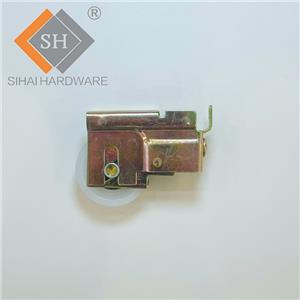
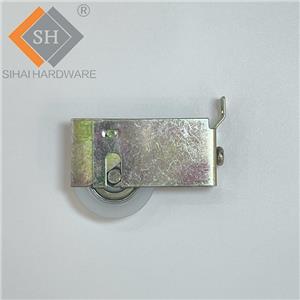
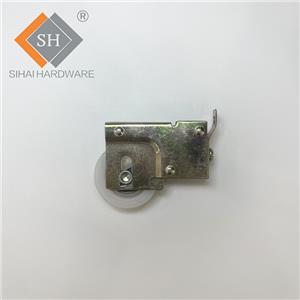
The housing that holds the roller wheel and bearing affects both initial installation and long-term maintainability. A housing with an eccentric adjustment mechanism allows the roller height to be fine-tuned without removing the door. This is valuable during installation, when the door must be precisely aligned with the frame, and during maintenance, when years of wear may have altered the door's position. A housing that is manufactured from stainless steel or corrosion-resistant coated steel will maintain its structural integrity in environments that would corrode unprotected metal. Plastic housings, while inexpensive, can crack under the repeated impact loads of daily use. The mounting method also matters. Rollers that are secured with a single central screw are faster to install but more prone to loosening under vibration than those with multiple fastening points. For daily use, multiple fasteners and a rigid, corrosion-resistant housing are indicators of a roller designed for service rather than for the lowest possible purchase price.
Cycle Testing and Certification
A roller that has been cycle-tested under standardised conditions provides a basis for comparing durability claims between manufacturers. Testing to standards such as EN 13126 subjects the roller to tens of thousands of cycles under specified load, measuring changes in operating force, vertical displacement, and functional integrity. A roller that has passed 50,000 or 100,000 cycle testing has demonstrated a defined level of durability. A roller for which no cycle test data is available is an unknown quantity, regardless of how robust it appears. For daily use applications where reliability matters, third-party certification provides assurance that the roller's performance has been verified by an independent laboratory rather than asserted by the manufacturer's marketing department.
Maintenance Access and Replacement Planning
Even the most durable roller will eventually require replacement. Selecting a roller that can be replaced without removing the door from its frame simplifies maintenance and reduces downtime. Some roller designs allow the wheel and bearing assembly to be removed and replaced while the housing remains mounted to the door, a feature that turns a potentially hour-long repair into a ten-minute task. For daily use doors in commercial settings, this maintainability translates directly to reduced disruption and lower lifecycle cost. The availability of replacement rollers should also be considered. A roller from a manufacturer who maintains spare parts inventory and provides clear part numbers is a safer long-term choice than an unbranded import that may be unavailable when replacement is needed.
Conclusion
Choosing a roller for daily use means looking past the static load rating to the specifications that determine how the roller will perform after tens of thousands of cycles. The bearing type predicts durability. The wheel material determines noise and wear characteristics. The load margin accommodates real-world conditions. The sealing protects against contamination. The housing design affects installation and maintenance. The cycle testing provides verified performance data. A roller selected on these criteria will cost more than a basic unit chosen on load rating alone. The premium is recovered through longer service life, fewer replacements, and a door that continues to operate smoothly long after an under-specified roller would have failed. In hardware selection for daily use, the cheapest option is rarely the least expensive when measured over the life of the door.