ARTICLE NO.139 | The Four Points of Contact: Why a Sliding Door Roller Fails When Any One Wheel Misaligns
ARTICLE NO.139 | The Four Points of Contact: Why a Sliding Door Roller Fails When Any One Wheel Misaligns
A sliding door appears to float effortlessly along its track, but this illusion of weightlessness conceals a demanding mechanical reality. The entire weight of the door panel—often exceeding 80 kilograms for a standard double-glazed patio door and reaching over 200 kilograms for commercial aluminium systems—is concentrated onto four small points of contact where the wheels of the roller assemblies meet the track. Each roller carries a quarter of the total load only under perfect conditions. The moment any single roller deviates from its designed alignment, the load distribution shifts dramatically, triggering a cascade of accelerated wear that propagates through the entire sliding system. Understanding how these four points of contact interact—and why misalignment at just one wheel can destroy a door's functionality—is essential for anyone who specifies, installs, or maintains sliding door hardware.
The Ideal Load Distribution
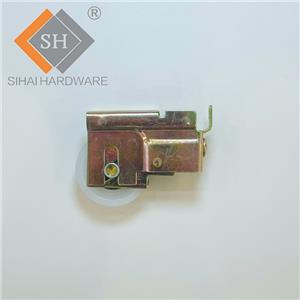
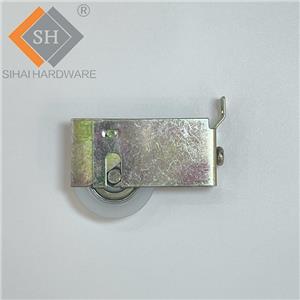
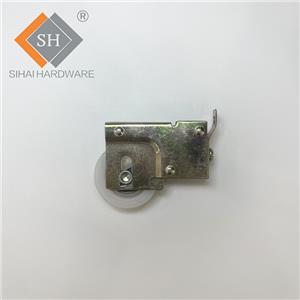
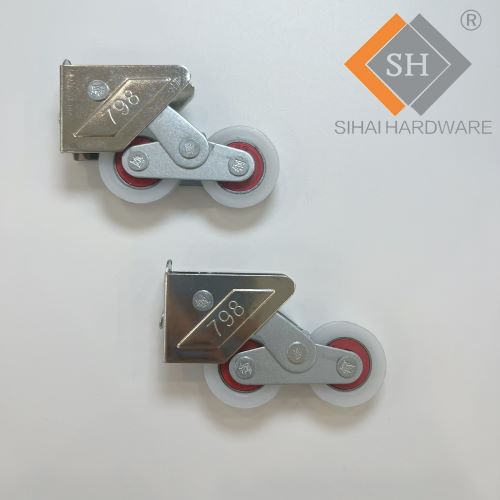
In a properly adjusted sliding door, two roller assemblies support the panel, with each assembly containing two wheels riding on a common track or twin parallel tracks. The door's weight creates a downward force vector that passes through the panel's centre of mass. This force resolves into four reaction forces at the wheel-track contact points. When the track is perfectly level, the roller mounting positions are correctly adjusted, and the door panel is square, each wheel bears exactly one-quarter of the total panel weight. This uniform distribution is the design assumption underlying the roller's load rating—a roller assembly rated for 100 kilograms is typically engineered with a safety factor of 1.5 to 2.0, meaning each wheel can safely sustain a static load of 25 to 33 kilograms. The wheel material, bearing type, axle diameter, and housing geometry are all optimised for this evenly distributed load case. Under these conditions, quality sliding door rollers manufactured with sealed ball bearings and precision-ground wheels can deliver 50,000 to 100,000 cycles of smooth, quiet operation with minimal wear.
The Mathematics of Misalignment
Misalignment in a sliding door roller system can originate from multiple sources. The track may be installed out of level by even a single millimetre across its length. The roller mounting brackets may be adjusted unevenly during installation, with one roller set slightly higher than its partner. The door panel itself may be fabricated slightly out of square, or it may distort over time due to thermal expansion, moisture absorption in timber frames, or settlement of the building structure. When any one of the four wheels loses contact with the track—or even when its contact force is significantly reduced—the load redistributes across the remaining wheels. If one wheel carries only 10 percent of its design load, the three remaining wheels must collectively support 90 percent of the panel weight, with the wheel diagonally opposite the unloaded wheel experiencing the greatest increase. This overloaded wheel now operates beyond its design capacity, and its rolling contact fatigue life decreases exponentially. Bearing life calculations based on the Lundberg-Palmgren theory show that a 30 percent increase in radial load reduces bearing fatigue life by approximately 50 percent. A 50 percent overload can reduce life by 70 to 80 percent. What was designed as a 20-year component can fail within 18 to 24 months under persistent misalignment conditions.
Wheel Wear Patterns as Diagnostic Evidence
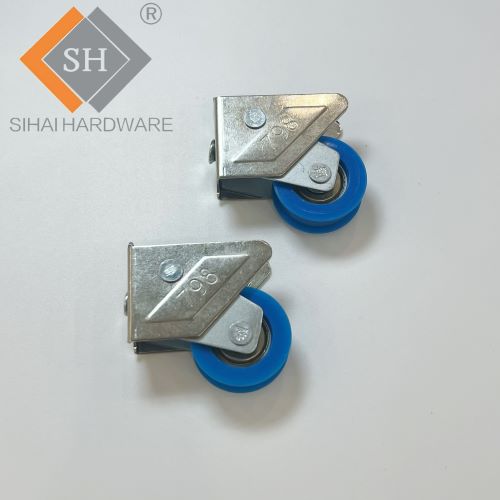
The wear pattern on a sliding door roller wheel provides a detailed record of its operating conditions. A wheel that has operated under correct alignment exhibits uniform, symmetrical wear across its tread surface—the contact band is centred on the wheel profile and consistent in width around the entire circumference. In contrast, a wheel operating under misalignment develops characteristic asymmetric wear patterns. If the track is out of level laterally, the wheel rides on one edge of its tread, producing a tapered wear profile that is visibly thinner on the loaded side. This tapered wheel then exacerbates the misalignment by effectively steering the door panel toward the low side of the track with each cycle. If the roller bracket is adjusted too high relative to its partner, the overloaded wheel develops a flattened spot—a condition known as brinelling—where repeated impact with the track during door operation plastically deforms the wheel material. Once a flat spot develops, the wheel no longer rolls smoothly; it thumps over the track with each pass, transmitting impact loads through the roller housing and into the door panel. These impact loads can loosen mounting screws, crack roller housings, and in severe cases, cause the glass unit to lose its seal due to repeated vibration.
Cascading Failure: How One Bad Roller Kills the System
A sliding door system exhibits a property that reliability engineers call dependent failures: the failure of one roller significantly increases the probability of failure in the remaining rollers. When one wheel degrades, the panel's rolling resistance increases. The user must apply greater force to operate the door, which in turn increases the lateral forces transmitted through the remaining roller assemblies. These increased lateral forces accelerate wear on the roller bearing seals, allowing dust and moisture ingress that degrades bearing lubrication. The increased operating effort also stresses the handle, the lock mechanism, and the door panel joints. What begins as a single misaligned roller wheel progresses through a predictable failure sequence. First, the user notices increased operating effort—the door feels heavy or sticks at certain points along the track. Second, audible symptoms develop: grinding from bearing failure, squeaking from dry wheel-track contact, or thumping from a flat-spotted wheel. Third, the door becomes visibly misaligned, with uneven gaps between the panel and frame. Finally, the door becomes inoperable—either jamming completely or derailing from the track. At this final stage, the repair cost has escalated from a simple roller replacement to potentially requiring new track sections, frame repairs, and in the worst case, a replacement glass unit if vibration damage has occurred.
Prevention Through Specification and Installation
Preventing sliding door roller failure begins long before the door is installed. Specifying rollers with adequate load capacity is the first line of defence—the total rated capacity of all rollers should exceed the actual door weight by a factor of at least 1.5, and preferably 2.0 for high-traffic or commercial applications. The roller material must be matched to the track material to minimise both wear and corrosion: stainless steel or nickel-plated steel rollers on stainless steel tracks, or engineered polymer rollers with internal bearings for aluminium tracks where galvanic compatibility is essential. During installation, the track must be levelled to within 0.5 millimetres per metre of length, a tolerance that demands laser levelling tools rather than spirit levels. Roller height adjustment must be performed systematically, verifying that all four wheels make simultaneous contact with the track and that the door panel is plumb and square within the frame opening. This adjustment should be rechecked after the door has been cycled approximately 50 times, as the rollers settle into their final positions. Finally, specifying rollers with eccentric adjustment mechanisms allows fine-tuning of each wheel's contact force without dismounting the door panel—a feature that dramatically simplifies both initial setup and maintenance adjustments over the door's service life.
Conclusion
The four points of contact in a sliding door roller system function as an interdependent mechanical network. The failure of any single wheel is never an isolated event—it represents a load redistribution that accelerates wear in the remaining rollers, increases operating forces, and propagates damage throughout the entire door assembly. A sliding door that operates smoothly today may be accumulating the hidden damage of misalignment that will manifest months or years later as a catastrophic failure. The lessons for specification and maintenance are clear: specify rollers with generous load margins, demand precision in track installation and roller adjustment, and respond immediately to the earliest signs of increased operating effort or changed sound signature. The roller wheel, so small relative to the door it supports, proves itself to be the component upon which the entire sliding system depends. When all four points share the load equally, the door glides. When even one point fails, the door grinds toward a premature and preventable end.