ARTICLE NO.136 | The Fatigue Threshold: How Many Cycles Before Your Continuous Hinge Fails?
ARTICLE NO.136 | The Fatigue Threshold: How Many Cycles Before Your Continuous Hinge Fails?
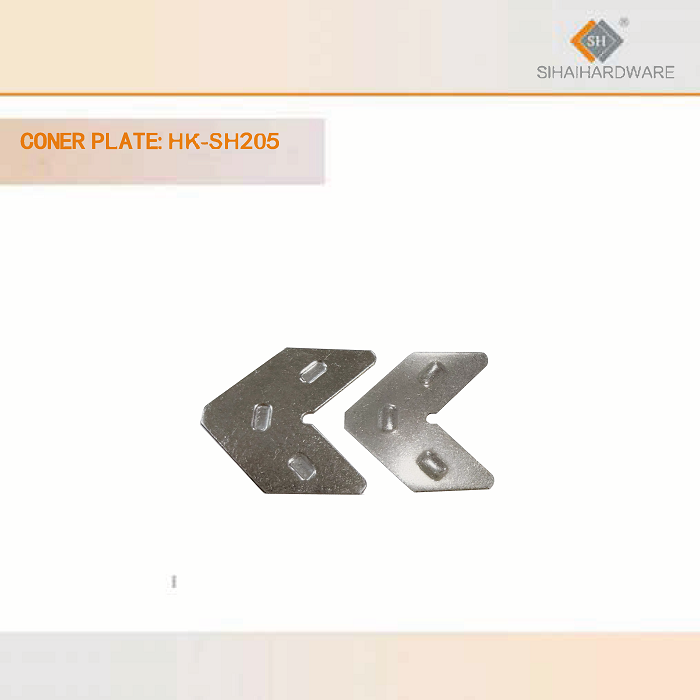
The Corner Brace in architectural hardware is typically associated with static reinforcement—a rigid bracket resisting racking, shear, and torsional deformation. Yet in automated doors, high-traffic entrances, and industrial access panels, Corner Braces endure cyclic loading far beyond static design assumptions. Every opening and closing cycle introduces stress fluctuations that can initiate and propagate fatigue cracks over time. Unlike a visible hinge that announces wear through slowness or noise, a Corner Brace under cyclic loading accumulates invisible fatigue damage until catastrophic fracture occurs. Understanding how many cycles these components can endure, what factors accelerate failure, and how design influences fatigue life is essential for any engineer specifying hardware for high-cycle applications.
The Fatigue Mechanism in Metal Brackets
Fatigue failure in a Corner Brace progresses through three stages: crack initiation, crack propagation, and final fracture. Initiation begins at microscopic stress concentrations—fastener thread roots, fillet weld toes, sharp corners at punched holes, or surface imperfections from forming. At these locations, local stress can exceed yield strength even while nominal stress remains elastic. Each loading cycle causes localised plastic deformation, accumulating slip bands that form micro-cracks typically 0.01 to 0.1 millimetres long. The second stage sees these cracks propagate incrementally with each cycle, advancing micrometres at a time driven by the stress intensity factor range at the crack tip. At this stage, cracks remain undetectable by routine visual inspection. Final fracture occurs when the remaining uncracked cross-section can no longer support the applied load, resulting in sudden, brittle failure. A brace that has performed reliably for years can fail without warning once the fatigue crack reaches critical size.
Stress Concentration: The Fatigue Initiator
The geometry of a Corner Brace inherently creates conditions for fatigue initiation. Standard braces feature multiple fastener holes, each representing a geometric discontinuity where stress concentrates. For a hole in a plate under uniaxial tension, the theoretical stress concentration factor approaches 3.0—peak stress at the hole edge triples the nominal stress. Under combined bending and axial loading in real installations, actual concentrations can exceed this due to hole interactions, edge proximity, and eccentric load paths. Punched holes are particularly damaging. The punching process leaves a rough, micro-cracked surface with residual tensile stresses that provide abundant initiation sites. Drilled holes, while smoother, still retain machining marks that act as stress raisers. The fatigue life difference between punched-hole and drilled-hole braces of identical geometry can exceed a factor of three. Premium fatigue-resistant designs specify reamed or honed holes with chamfered edges, increasingly manufactured using fine-blanking processes that produce fully sheared edges with minimal residual stress.
The S-N Curve and Endurance Limits
Fatigue performance of a Corner Brace is characterised by its S-N curve—applied stress range plotted against cycles to failure. For ferrous alloys, including carbon and stainless steels, the curve exhibits a distinct knee at approximately one to ten million cycles. Below this endurance limit, the material theoretically withstands infinite cycles provided stress remains below 35 to 50 percent of ultimate tensile strength for smooth specimens. Stress concentrations dramatically reduce this threshold. A steel brace with punched holes may exhibit an effective endurance limit of only 15 to 25 percent of tensile strength when tested as a complete assembly. For aluminium Corner Braces—commonly 6063-T5 or 6061-T6 for window and curtain wall applications—the situation differs fundamentally. Aluminium alloys exhibit no true endurance limit; their S-N curves continue declining beyond ten million cycles. An aluminium brace under cyclic loading will eventually fail regardless of how low the applied stress, though design life may still exceed building service life at sufficiently low stress ranges.
Cycle Counting in Real-World Applications
Determining service cycles for a Corner Brace requires analysing the specific application. In residential window frames, two to four cycles daily accumulate perhaps 1,500 annually—well within the high-cycle regime where infinite-life design is straightforward. In automatic commercial entrance doors, 200 to 500 daily cycles produce 70,000 to 180,000 annually. Over twenty years, this reaches two to four million cycles—entering the transition region where endurance limit considerations become critical. In industrial access panels operating across three shifts, daily cycles can exceed 2,000, producing over 700,000 annually and well over ten million across the design life. At this intensity, even steel components operating below their theoretical endurance limit may fail from occasional overload events—wind gusts, forcing misaligned doors, or impact from equipment—that introduce stress ranges exceeding the limit for a small fraction of total cycles.
Design Strategies for Extended Fatigue Life
Extending fatigue life begins with reducing stress concentrations in the Corner Brace. Replacing punched holes with drilled and reamed holes, or specifying fine-blanked holes, reduces the stress concentration factor at vulnerable locations. Generous fillet radii at internal corners—rather than sharp 90-degree transitions—distribute stress more uniformly. In welded assemblies, post-weld treatments such as toe grinding or needle peening introduce compressive residual stresses that counteract tensile stresses driving crack propagation. Material selection plays an equally critical role. For high-cycle applications, specifying steel with a defined endurance limit provides inherent fatigue resistance over aluminium. Where aluminium is required for corrosion resistance or weight considerations, 6061-T6 provides approximately 15 to 20 percent higher fatigue strength than 6063-T5. Fastener specification also matters: preloaded bolts creating clamp friction between brace and connected members reduce the stress range experienced by the brace itself, as part of the load transfers through friction rather than through the brace cross-section, potentially doubling effective fatigue life.
Inspection and Replacement Triggers
For existing installations where Corner Brace fatigue failure carries significant consequences—overhead glazing supports, safety barrier connections, structural bracing in seismic zones—systematic inspection is essential. Visual inspection detects fatigue cracks once they reach 2 to 5 millimetres in length, though remaining life may then be short. Dye penetrant and magnetic particle inspection offer higher sensitivity, detecting cracks as small as 0.5 millimetres. For critical applications, periodic replacement at predetermined intervals based on estimated cycle accumulation provides the highest assurance. The replacement interval should use conservative daily cycle estimates, fatigue design curves with appropriate safety factors, and consideration of failure consequences. A brace whose failure would cause glass panel collapse warrants replacement at one-tenth or less of calculated minimum fatigue life.
Conclusion
The question of how many cycles a Corner Brace endures before failure has no single answer—it depends on material, manufacturing method, stress concentration geometry, loading conditions, and environment. A well-designed steel brace with properly finished holes, operating below its endurance limit, may provide infinite fatigue life practically. The same component with punched holes, exposed to occasional overloads, or made from aluminium without a true endurance limit, has a finite and calculable fatigue life. For the specifying engineer, the key recognition is that a Corner Brace is not merely a static bracket but a dynamically loaded structural component whose fatigue performance demands evaluation with the same rigour applied to any cyclically loaded element. Specifications should address manufacturing quality for holes and welds, material grade, and where appropriate, a defined replacement interval.