ARTICLE NO.134 | The Hidden Valve: How Hydraulic Damping Controls a Floor Spring's Closing Speed
ARTICLE NO.134 | The Hidden Valve: How Hydraulic Damping Controls a Floor Spring's Closing Speed
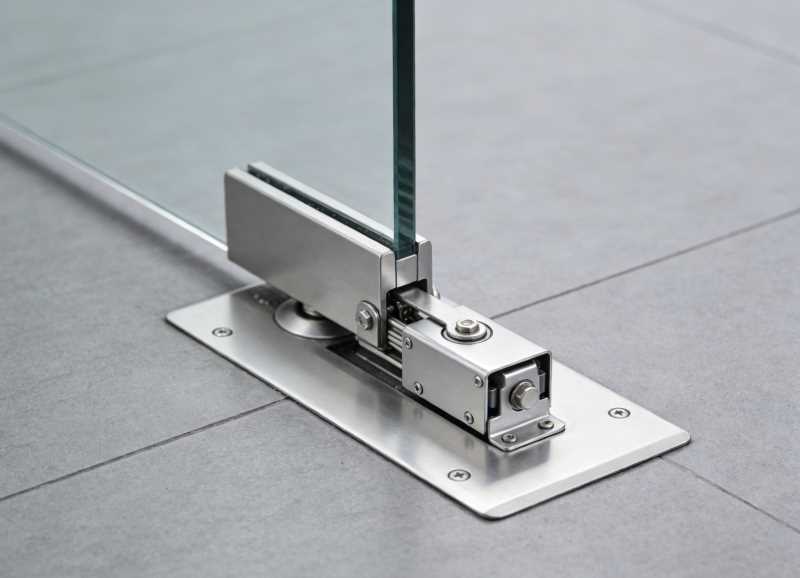
The Floor Spring is among the most technically sophisticated components concealed within modern architecture. Buried beneath the finished floor, it silently controls the movement of heavy glass and timber doors through millions of open-close cycles without maintenance access. While the external pivot and connecting spindle are all that remain visible above floor level, the true engineering complexity resides in a miniature hydraulic system hidden within the cemented body. At the heart of this system lies a network of precision valves that govern every phase of the door's movement—how quickly it closes, how gently it latches, and how firmly it resists being thrown open by wind or misuse. Understanding how these hidden valves operate, and how their calibration determines real-world door performance, is essential for anyone who specifies, installs, or maintains these remarkable devices.
The Hydraulic Circuit: A Masterpiece of Miniature Engineering
The Floor Spring converts the kinetic energy of an opening door into stored spring potential energy, then releases it in a controlled manner through hydraulic damping. The hydraulic system consists of a piston translating within a sealed cylinder filled with specially formulated hydraulic oil. As the door opens, a cam and roller assembly compresses a heavy-duty helical spring while the piston displaces oil through a unidirectional check valve circuit with minimal resistance. During the closing cycle, the spring drives the piston in reverse, and the oil is now forced through an entirely separate circuit of adjustable restriction valves. This bifurcation of opening and closing flow paths is the defining feature that separates a true Floor Spring from simpler types of door closers. Because the opening and closing circuits are hydraulically independent, the closing speed, latching speed, and back-check resistance can each be adjusted without affecting the others. The oil itself is a precision-formulated fluid with carefully controlled viscosity characteristics, containing anti-wear additives, corrosion inhibitors, oxidation stabilisers, and anti-foaming agents to maintain consistent performance across the spring's design life.
Closing Speed Valve: The Primary Speed Governor
The closing speed valve is the most frequently adjusted component in a Floor Spring. It controls the door's movement through approximately the first 85 percent of its closing arc—from the fully open or hold-open position down to about 15 degrees before the latch engages. Physically, this valve consists of a tapered needle screw that threads into a precision-machined orifice. As the needle is turned clockwise, its tapered tip advances into the orifice, progressively reducing the cross-sectional flow area. Because the oil is viscous and incompressible, reducing this area directly limits the volumetric flow rate at which oil can pass from one side of the piston to the other. Since the piston displacement is mechanically linked to door rotation through the rack-and-pinion or cam-drive mechanism, limiting the oil flow rate directly limits the door's angular velocity. The relationship between needle position and closing time is non-linear: the first quarter-turn of the adjustment screw may reduce closing speed by 20 percent, while the last quarter-turn before the valve seats fully closed can reduce speed by over 60 percent. This sensitivity explains why inexperienced adjusters often struggle to achieve consistent results. The ideal adjustment sets the closing speed fast enough to ensure reliable latching from small opening angles, yet slow enough to prevent the door from developing dangerous momentum that could injure a trailing pedestrian or overwhelm the latch mechanism.
Latching Speed Valve: The Final Gentle Approach
The latching speed valve governs the final phase of a Floor Spring door's closing cycle. Once the door reaches approximately 15 degrees from the fully closed position, the main closing speed circuit closes and oil is diverted through a separate micro-orifice controlled by the latching speed valve. This transition is achieved through a bypass port in the cylinder wall: as the piston passes this port near the end of its stroke, the primary oil path is blocked and the remaining flow is forced through the latching circuit. The latching valve orifice is typically one-quarter to one-tenth the diameter of the closing speed orifice at its typical setting. This creates a much higher flow resistance, slowing the door dramatically in the final inches of travel. This deceleration serves multiple functions: it prevents the door from slamming against the frame, which would generate noise and potentially damage the glass, seals, or frame; it gives the latch bolt or multi-point locking system time to align with the strike plate; and it allows the door's momentum to dissipate so that the latch engages by mechanical advantage rather than by impact. If the latching speed is set too fast, the latch may bounce off the strike and fail to engage—a condition known as latch skip that leaves the door unsecured. If set too slow, the door may stall before reaching the fully closed position, particularly in cold weather when increased oil viscosity further reduces flow rates.
Back-Check Valve: Protection Against Over-Opening
The back-check function in a Floor Spring operates on a fundamentally different principle than the closing speed controls. While the closing and latching valves regulate flow that is being driven by the compressed spring, the back-check valve is actuated by the door being opened. When the door is pushed open with force—whether by a gust of wind, an impatient user, or accidental impact—the piston displaces oil at a rate far exceeding the design closing flow. If unchecked, the door would swing open violently until it struck an adjacent wall, a door stop, or reached the mechanical limit of the pivot mechanism. The back-check valve prevents this by introducing a secondary flow restriction that activates only at a specific door angle, typically around 70 to 85 degrees. This is commonly accomplished using a separate piston bypass port that is uncovered only when the piston reaches a position corresponding to this opening angle. As soon as the port opens, oil flows through the back-check circuit, and the adjustable needle valve in this circuit creates hydraulic resistance that cushions the door's final opening movement. The back-check does not prevent the door from opening wide—it controls the speed at which it reaches its full-open position. Setting the back-check requires balancing protection with usability: too aggressive a setting prevents the door from opening fully under normal operation, while too weak a setting offers insufficient protection for the pivot mechanism and adjacent walls.
Delayed Action: The Hold-Open Hydraulic Timer
Some Floor Spring models incorporate a delayed action feature that holds the door open for an adjustable period before initiating closure. This is particularly valuable for accessibility applications, where a slow-closing door allows wheelchair users or persons with limited mobility sufficient time to pass through the opening. The delayed action circuit functions by trapping oil in a separate accumulator chamber when the door reaches its fully open position. A small bleed valve allows this oil to escape at a controlled rate, and only when sufficient oil has been released does the main spring overcome the hydraulic lock and begin the closing cycle. The delay period is adjusted by setting this bleed valve, with typical adjustment ranges spanning from a few seconds to over 30 seconds. The delayed action mechanism introduces additional complexity to the hydraulic circuit, requiring additional seals, check valves, and precisely machined accumulator volumes. This complexity increases both manufacturing cost and potential failure points, which is why delayed action is typically offered as an optional feature rather than included as standard.
Conclusion
The hidden hydraulic valves within a Floor Spring represent a remarkable convergence of fluid dynamics, precision manufacturing, and practical engineering. The closing speed valve metering the main return stroke, the latching valve softening the final approach, the back-check valve absorbing opening impacts, and the delayed action system accommodating accessibility needs, all operate silently within a sealed unit beneath the floor. Their proper adjustment requires understanding the interdependence of these circuits—a change to the closing speed alters the pressure conditions seen by the latching and back-check valves, and adjustments must be made in the correct sequence: back-check first, then closing speed, then latching speed, and finally delayed action if fitted. The hidden valve system within a Floor Spring is invisible to building occupants, yet its reliable function is experienced every time a heavy door closes with controlled, silent precision.