ARTICLE NO.130 | The Mechanical Secret of Window Stays: Why the Brace Angle Locks at 45°
ARTICLE NO.130 | The Mechanical Secret of Window Stays: Why the Brace Angle Locks at 45°
The window friction stay is a deceptively simple component—push the sash open, and it holds; pull it closed, and it releases. Yet within this everyday action lies a precision-engineered mechanical system refined over decades. Among the many parameters governing its performance, one remains remarkably consistent across manufacturers and national standards: the brace arm locks at approximately 45 degrees when the sash reaches full extension. This is no arbitrary convention. The 45-degree orientation represents a mathematically optimal convergence of force resolution, buckling resistance, and wear minimization.
The Kinematic Chain
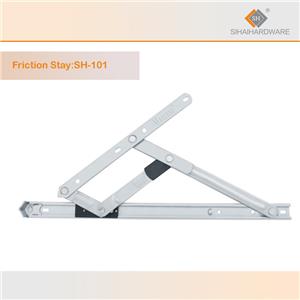
A window friction stay operates through a slider-crank mechanism consisting of a track on the fixed frame, a sliding shoe within the track, a connecting arm linking shoe to sash bracket, and a secondary stabilizing arm. As the sash opens, the shoe travels linearly while the arm angle changes continuously. Mechanical advantage varies throughout the stroke—low at small angles, increasing near full extension as the geometry approaches an over-center condition. The 45-degree terminal position balances three competing demands: sufficient leverage for easy closing, arm orientation resisting compressive buckling, and friction shoe normal forces within design limits.

window friction stay
Force Resolution
The window friction stay connecting arm functions as a two-force member under wind load. When a gust strikes the open sash, the force vector resolves into parallel and perpendicular components at the sash bracket. At exactly 45 degrees, these components are equal in magnitude. Steeper angles amplify the perpendicular component, increasing friction mechanism demand and accelerating shoe-track wear. Shallower angles increase the parallel component, elevating buckling risk in the slender arm. Finite element analyses consistently show peak von Mises stresses minimized when the terminal angle approaches 45 degrees, confirming balanced stress distribution across the entire mechanism.
window friction stay
Buckling Stability
The connecting arm of a window friction stay is inherently slender—typically 200 to 400 millimeters long with a cross-section of only 8 to 15 millimeters. Under compressive wind load, it behaves as an eccentrically loaded column governed by Euler's formula. At 45 degrees, partial end restraint from both shoe and sash bracket connections reduces the effective length factor to approximately 0.7 to 0.8 of geometric length. Reducing the angle to 30 degrees increases projected length in the compression direction, lowering buckling capacity by 30 to 40 percent. At 60 degrees, improved slenderness comes at the cost of overstressed friction retention. The 45-degree angle sits precisely at the intersection of the buckling resistance curve and friction capacity curve.
window friction stay
Tribological Optimization
The sliding shoe in a window friction stay converts sash rotation into linear displacement while generating controlled friction through a pad pressed against the stainless steel track. Normal force at the interface varies with arm angle. At 45 degrees, the reactive couple balancing arm forces is minimized, reducing peak contact pressures at shoe extremities. Wear testing across opening angles from 30 to 60 degrees reveals a U-shaped wear rate curve with a minimum at approximately 43 to 47 degrees. Steeper angles concentrate wear at shoe tips; shallower angles increase sliding distance per degree of rotation, accelerating abrasive wear. Operating at 45 degrees extends service life by maintaining the most uniform contact pressure distribution.
Manufacturing Tolerance
The window friction stay is mass-produced to commercial tolerances of plus or minus 0.1 to 0.3 millimeters on pivot positions and slot dimensions. Small deviations propagate through the kinematic chain, shifting the terminal angle. Sensitivity analysis reveals that a 0.2-millimeter pivot error shifts the terminal angle by approximately 1.2 degrees at a 45-degree nominal, compared to 2.8 degrees at 30 degrees. This reduced sensitivity occurs because the rate of change of mechanical advantage with respect to angle reaches its minimum near 45 degrees for this slider-crank geometry. The result is consistent performance across production batches—a manufacturing robustness that underpins the industry-wide convergence on the 45-degree standard.
Practical Implications
Understanding the 45-degree principle in window friction stay design has direct practical implications. For a casement window with 600-millimeter opening width, a standard 300-millimeter arm achieves the 45-degree terminal angle naturally. Wider openings require longer arms to maintain the relationship; simply extending the same arm steeper reduces holding force and accelerates wear. Track mounting position critically influences geometry—a 5-millimeter deviation shifts the terminal angle by 2 to 3 degrees. When replacing worn stays, matching both arm length and original track position preserves the engineered geometry. Substituting different dimensions without geometric recalculation compromises both performance and service life.
Conclusion
The 45-degree brace angle in the window friction stay represents a carefully optimized convergence of structural mechanics, tribology, and manufacturing pragmatism. At this angle, force components balance, buckling resistance maximizes relative to friction demand, wear minimizes, and manufacturing sensitivity reaches its lowest point. For specifiers, installers, and maintenance technicians, the 45-degree principle provides a reliable engineering benchmark. When maintained at its designed optimum, the window friction stay delivers decades of silent, secure service—a performance that belies the elegant simplicity of its triangular geometry.